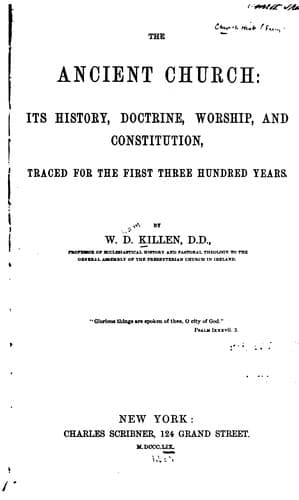
The Ancient Church: Its History, Doctrine, Worship, and ConstitutionKillen, W. D. (William Dool)
Religion
The Ancient Church: Its History, Doctrine, Worship, and Constitution
Killen, W. D. (William Dool)
Church history -- Primitive and early church, ca. 30-600
It is reported by several ancient writers that the apostles were
instructed to remain at Jerusalem for twelve years after the crucifixion
of our Lord, [66:3] and if the tradition is correct, the holy city
continued to be their stated residence until shortly before the period
of the arrival of these deputies from the Syrian capital. The time of
this visit can be pretty accurately ascertained, and there is perhaps no
point connected with the history of the book of the Acts respecting
which there is such a close approximation to unanimity amongst
chronologists; for, as Josephus notices [66:4] both the sudden death of
Herod Agrippa, grandson of Herod the Great, which now occurred, [66:5]
and the famine against which this contribution was intended to provide,
it is apparent from the date which he assigns to them, that Barnabas and
Saul must have reached Jerusalem about A.D. 44. [66:6] At this juncture
at least two of the apostles, James the brother of John, and Peter, were
in the Jewish capital; and it is probable that all the rest had not yet
finally taken their departure. The Twelve, it would seem, did not set
out on distant missions until they were thoroughly convinced that they
had ceased to make progress in the conversion of their countrymen in the
land of their fathers. And it is no trivial evidence, at once of the
strength of their convictions, and of the truth of the evangelical
history, that they continued so long and so efficiently to proclaim the
gospel in the chief city of Palestine. Had they not acted under an
overwhelming sense of duty, they would not have remained in a place
where their lives were in perpetual jeopardy; and had they not been
faithful witnesses, they could not have induced so many, of all classes
of society, to believe statements which, if unfounded, could have been
easily contradicted on the spot. The apostles must have been known to
many in Jerusalem as the companions of our Lord; for, during His public
ministry, they had often been seen with Him in the city and the temple;
and it was to be, therefore, expected, that peculiar importance would be
attached to their testimony respecting His doctrines and His miracles.
Their preaching in the head-quarters of Judaism was fitted to exert an
immense influence, as that metropolis itself contained a vast
population, and as it was, besides, the resort of strangers from all
parts of the world. And so long as the apostles ministered in Jerusalem
or in Palestine only to the house of Israel, it was expedient that their
number, which was an index of the Divine regard for the whole of the
twelve tribes, should be maintained in its integrity. But when, after
preaching twelve years among their countrymen at home, they found their
labours becoming comparatively barren; and when, driven by persecution
from Judea, they proceeded on distant missions, their position was quite
altered. Their number had now at least partially [67:1] lost its
Public-domain text, read in full here on John Shaqi.
Reviews
Reviews
No reviews yet
Be the first to share your thoughts on this work.
Elsewhere in the archive
Join the Discussion
Join the discussion
Sign in to leave a comment or review.
Sign InorCreate an account