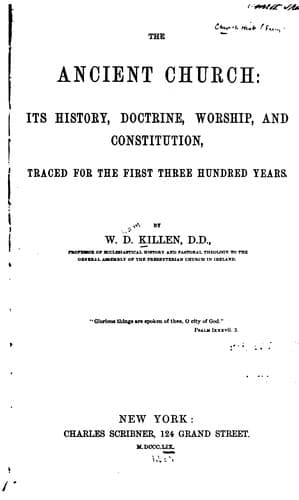
The Ancient Church: Its History, Doctrine, Worship, and ConstitutionKillen, W. D. (William Dool)
Religion
The Ancient Church: Its History, Doctrine, Worship, and Constitution
Killen, W. D. (William Dool)
Church history -- Primitive and early church, ca. 30-600
In the circumstantial record of this proceeding, to be found in the Acts
of the Apostles, we have a proof of the wisdom of the Author of
Revelation. He foresaw that the rite of "the laying on of hands" would
be sadly abused; that it would be represented as possessing something
like a magic potency; and that it would be at length converted, by a
small class of ministers, into an ecclesiastical monopoly. He has,
therefore, supplied us with an antidote against delusion by permitting
us, in this simple narrative, to scan its exact import. And what was the
virtue of the ordination here described? Did it furnish Paul and
Barnabas with a title to the ministry? Not at all. God himself had
already called them to the work, and they could receive no higher
authorisation. Did it necessarily add anything to the eloquence, or the
prudence, or the knowledge, or the piety, of the missionaries? No
results of the kind could be produced by any such ceremony. What then
was its meaning? The evangelist himself furnishes an answer. The Holy
Ghost required that Barnabas and Saul should be _separated_ to the work
to which the Lord had called them, and the laying on of hands was the
_mode_, or _form_, in which they were set apart, or designated, to the
office. This rite, to an Israelite, suggested grave and hallowed
associations. When a Jewish father invoked a benediction on any of his
family, he laid his hand upon the head of the child; [73:1] when a
Jewish priest devoted an animal in sacrifice, he laid his hand upon the
head of the victim; [73:2] and when a Jewish ruler invested another with
office, he laid his hand upon the head of the new functionary. [73:3]
The ordination of these brethren possessed all this significance. By the
laying on of hands the ministers of Antioch implored a blessing on
Barnabas and Saul, and announced their separation, or dedication, to the
work of the gospel, and intimated their investiture with ecclesiastical
authority.
Public-domain text, read in full here on John Shaqi.
Reviews
Reviews
No reviews yet
Be the first to share your thoughts on this work.
Elsewhere in the archive
Join the Discussion
Join the discussion
Sign in to leave a comment or review.
Sign InorCreate an account