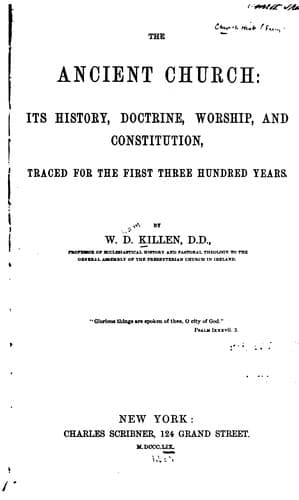
The Ancient Church: Its History, Doctrine, Worship, and ConstitutionKillen, W. D. (William Dool)
Religion
The Ancient Church: Its History, Doctrine, Worship, and Constitution
Killen, W. D. (William Dool)
Church history -- Primitive and early church, ca. 30-600
trodden by the feet of a Christian missionary, they returned to Antioch
in Syria to rehearse "all that God had done with them, and how he had
opened the door of faith unto the Gentiles." [76:6]
Paul and Barnabas spent about six years in this first tour; [76:7] and,
occasionally, when their ministrations were likely to exert a wide and
permanent influence, remained long in particular localities. The account
of their designation, and of their labours in Cyprus, Pamphylia,
Lycaonia, and the surrounding regions, occupies two whole chapters of
the Acts of the Apostles. The importance of their mission may be
estimated from this lengthened notice. Christianity now greatly extended
its base of operations, and shook paganism in some of its strongholds.
In every place which they visited, the apostles observed a uniform plan
of procedure. In the first instance, they made their appeal to the seed
of Abraham; as they were themselves learned Israelites, they were
generally permitted, on their arrival in a town, to set forth the claims
of Jesus of Nazareth in the synagogue; and it was not until the Jews had
exhibited a spirit of unbelief, that they turned to the heathen
population. In the end, by far the majority of their converts were
reclaimed idolaters. "The Gentiles were glad, and glorified the word of
the Lord, and as many as were ordained to eternal life, believed."
[77:1] Astonished at the mighty miracles exhibited by the two
missionaries, the pagans imagined that "the gods" had come down to them
"in the likeness of men;" and at Lystra the priest of Jupiter "brought
oxen and garlands unto the gates, and would have done sacrifice with the
people;" [77:2] but the Jews looked on in sullen incredulity, and kept
alive an active and implacable opposition. At Cyprus, the apostles had
to contend against the craft of a Jewish conjuror; [77:3] at Antioch,
"the Jews stirred up the devout and honourable women, and the chief men
of the city, and raised persecution" against them, "and expelled them
out of their coasts;" [77:4] at Iconium, the Jews again "stirred up the
Gentiles, and made their minds evil affected against the brethren;"
[77:5] and at Lystra, the same parties "persuaded the people, and having
stoned Paul, drew him out of the city, supposing he had been dead"
[78:1] The trials through which he now passed seem to have made an
indelible impression on the mind of the great apostle, and in the last
of his epistles, written many years afterwards, he refers to them as
among the most formidable he encountered in his perilous career.
Timothy, who at this time must have been a mere boy, appears to have
witnessed some of these ebullitions of Jewish malignity, and to have
marked with admiration the heroic spirit of the heralds of the Cross.
Paul, when about to be decapitated by the sword of Nero, could,
therefore, appeal to the evangelist, and could fearlessly declare that,
twenty years before, when his life was often at stake, he had not
Public-domain text, read in full here on John Shaqi.
Reviews
Reviews
No reviews yet
Be the first to share your thoughts on this work.
Elsewhere in the archive
Join the Discussion
Join the discussion
Sign in to leave a comment or review.
Sign InorCreate an account