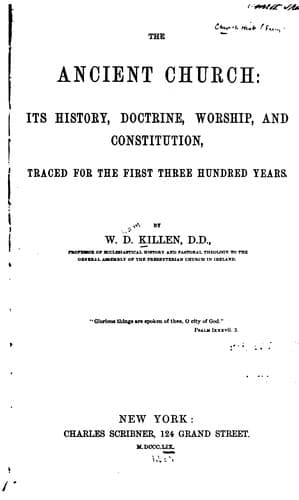
The Ancient Church: Its History, Doctrine, Worship, and ConstitutionKillen, W. D. (William Dool)
Religion
The Ancient Church: Its History, Doctrine, Worship, and Constitution
Killen, W. D. (William Dool)
Church history -- Primitive and early church, ca. 30-600
It may at first sight appear strange that whilst the apostles, and those
who acted with them at this meeting, condemned the doctrine of the
Judaizers, and affirmed that circumcision was not obligatory on the
Gentiles, they, at the same time, required the converts from paganism to
observe a part of the Hebrew ritual; and it may seem quite as
extraordinary that, in a letter which was the fruit of so much
deliberation, they placed an immoral act, and a number of merely
ceremonial usages, in the same catalogue. But, on mature reflection, we
may recognise their tact and Christian prudence in these features of
their communication. Fornication was one of the crying sins of
Gentilism, and, except when it interfered with social arrangements, the
heathen did not even acknowledge its criminality. When, therefore, the
new converts were furnished with the welcome intelligence that they were
not obliged to submit to the painful rite of circumcision, it was well,
at the same time, to remind them that there were lusts of the flesh
which they were bound to mortify; and it was expedient that, whilst a
vice so prevalent as fornication should be specified, they should be
distinctly warned to beware of its pollutions. For another reason they
were directed to abstain from "meats offered to idols." It often
happened that what had been presented at the shrine of a false god was
afterwards exposed for sale, and the council cautioned the disciples
against partaking of such food, as they might thus appear to give a
species of sanction to idolatry, as well as tempt weak brethren to go a
step further, and directly countenance the superstitions of the heathen
worship. [88:1] The meeting also instructed the faithful in Syria and
Cilicia to abstain from "blood and from things strangled," because the
Jewish converts had been accustomed from infancy to regard aliment of
this description with abhorrence, and they could scarcely be expected to
sit at meat with parties who partook of such dishes. Though the use of
them was lawful, it was, at least for the present, not expedient; and on
the same principle that, whether we eat, or drink, or whatever we do, we
should do all to the glory of God, the Gentile converts were admonished
to remove them from their tables, that no barrier might be raised up in
the way of social or ecclesiastical communion with their brethren of the
seed of Abraham.
Public-domain text, read in full here on John Shaqi.
Reviews
Reviews
No reviews yet
Be the first to share your thoughts on this work.
Elsewhere in the archive
Join the Discussion
Join the discussion
Sign in to leave a comment or review.
Sign InorCreate an account