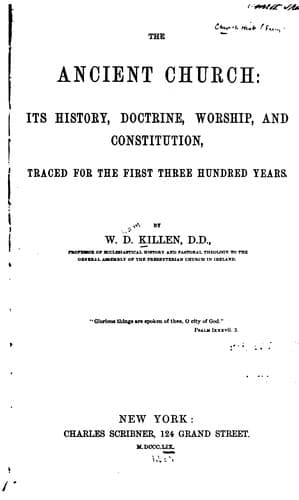
The Ancient Church: Its History, Doctrine, Worship, and ConstitutionKillen, W. D. (William Dool)
Religion
The Ancient Church: Its History, Doctrine, Worship, and Constitution
Killen, W. D. (William Dool)
Church history -- Primitive and early church, ca. 30-600
Nearly a century before, two powerful factions, contending for the
government of the Roman world, had converted the district now visited
into a theatre of war; immense armies had been here drawn out in hostile
array; and two famous battles, which issued in the overthrow of the
Republic, had been fought in this very neighbourhood. The victor had
rewarded some of his veterans by giving them possessions at Philippi.
The Christian missionary entered, as it were, the suburbs of the great
metropolis of the West, when he made his appearance in this military
colony; for, it had the same privileges as the towns of Italy, [91:1]
and its inhabitants enjoyed the status of Roman citizens. Here he now
originated a spiritual revolution which eventually changed the face of
Europe. The Jews had no synagogue in Philippi; but, in places such as
this, where their numbers were few, they were wont, on the Sabbath, to
meet for worship by the side of some river in which they could
conveniently perform their ablutions; and Paul accordingly repaired to
the banks of the Gangitas, [91:2] where he expected to find them
assembled for devotional exercises. A small oratory, or house of prayer,
seems to have been erected on the spot; but the little society connected
with it must have been particularly apathetic, as the apostle found only
a few females in attendance. One of these was, however, the first-fruits
of his mission to the Western continent. Lydia, a native of Thyatira,
and a seller of purple,--a species of dye for which her birthplace had
acquired celebrity,--was the name of the convert; and though the gospel
may already have made some progress in Rome, it must be admitted that,
in as far as direct historical testimony is concerned, this woman has
the best claim to be recognised as the mother of European Christianity.
It is said that she "worshipped God," [91:3] that is, though a Gentile,
she had been proselyted to the Jewish faith; and the history of her
conversion is given by the evangelist with remarkable clearness and
simplicity. "The Lord _opened her heart_ that she attended unto the
things that were spoken of Paul." [91:4] When she and her family were
baptized, she entreated the missionaries to "come into her house and
abide there" during their sojourn in the place; and, after some
hesitation, they accepted the proffered hospitality.
Public-domain text, read in full here on John Shaqi.
Reviews
Reviews
No reviews yet
Be the first to share your thoughts on this work.
Elsewhere in the archive
Join the Discussion
Join the discussion
Sign in to leave a comment or review.
Sign InorCreate an account