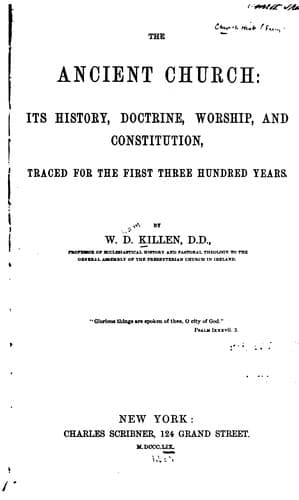
The Ancient Church: Its History, Doctrine, Worship, and ConstitutionKillen, W. D. (William Dool)
Religion
The Ancient Church: Its History, Doctrine, Worship, and Constitution
Killen, W. D. (William Dool)
Church history -- Primitive and early church, ca. 30-600
The result demonstrated that the apostle thus pursued the most effective
mode of advancing the Christian cause. It might, indeed, have been
thought that Corinth was a very ungenial soil for the gospel, as Venus
was the favourite deity of the place; and a thousand priestesses, or, in
other words, a thousand prostitutes, were employed in the celebration of
her orgies. [109:1] The inhabitants generally were sunk in the very
depths of moral pollution. But the preaching of the Cross produced a
powerful impression even in this hotbed of iniquity. Notwithstanding the
enmity of the Jews, who "opposed themselves and blasphemed," [109:2]
Paul succeeded in collecting here a large and prosperous congregation.
"Many of the Corinthians hearing, believed, and were baptized." [109:3]
Most of the converts were in very humble circumstances, and hence the
apostle says to them in his first epistle--"Ye see your calling,
brethren, how that not many wise men after the flesh, not many mighty,
not many noble are called;" [109:4] but still a few persons of
distinction united themselves to the despised community. Thus, it
appears [109:5] that Erastus, the chamberlain, or treasurer, of the
city, was among the disciples. It may be that this civic functionary
joined the Church at a somewhat later date; but, even now, Paul was
encouraged by the accession of some remarkable converts. Of these,
perhaps, the most conspicuous was Crispus, "the chief ruler of the
synagogue," who, "with all his house," submitted to baptism. [109:6]
About the same time Gaius, who seems to have been an opulent citizen,
and who rendered good service to the common cause by his Christian
hospitality, [109:7] openly embraced the gospel. Two other converts, who
are often honourably mentioned in the New Testament, were now likewise
added to the infant Church. These were Aquila and Priscilla. [109:8]
Some have, indeed, supposed that this couple had been already baptized;
but, on the arrival of Paul in Corinth, Aquila is represented as _a Jew_
[110:1]--a designation which would not have been descriptive of his
position had he been previously a believer--and we must therefore infer
that the conversion of himself and his excellent partner occurred at
this period.
Public-domain text, read in full here on John Shaqi.
Reviews
Reviews
No reviews yet
Be the first to share your thoughts on this work.
Elsewhere in the archive
Join the Discussion
Join the discussion
Sign in to leave a comment or review.
Sign InorCreate an account