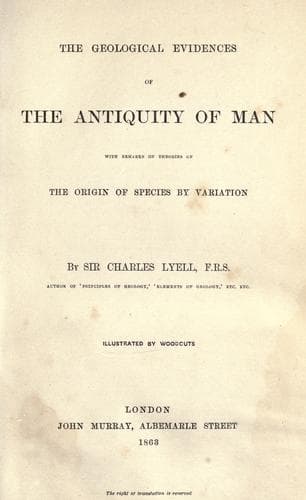
Evolution (Biology); Glacial epoch; Human beings -- Origin; Human evolution
In my former writings I have attributed this kind of derangement to two
causes; first, the pressure of ice running aground on yielding banks of
mud and sand; and, secondly, the melting of masses of ice and snow of
unequal thickness, on which horizontal layers of mud, sand, and other
fine and coarse materials had accumulated. The late Mr. Trimmer first
pointed out in what manner the unequal failure of support caused by the
liquefaction of underlying or intercalated snow and ice might give rise
to such complicated foldings.*
(* See chapter 12.)
When "ice-jams" occur on the St. Lawrence and other Canadian rivers
(latitude 46 degrees north), the sheets of ice, which become packed or
forced under or over one another, assume in most cases a highly inclined
and sometimes even a vertical position. They are often observed to be
coated on one side with mud, sand, or gravel frozen on to them, derived
from shallows in the river on which they rested when congelation first
reached the bottom.
As often as portions of these packs melt near the margin of the
river, the layers of mud, sand, and gravel, which result from their
liquefaction, cannot fail to assume a very abnormal arrangement--very
perplexing to a geologist who should undertake to interpret them without
having the ice-clue in his mind.
Mr. Prestwich has suggested that ground-ice may have had its influence
in modifying the ancient alluvium of the Somme.*
(* Prestwich, Memoir read to Royal Society, April 1862.)
It is certain that ice in this form plays an active part every winter
in giving motion to stones and gravel in the beds of rivers in European
Russia and Siberia. It appears that when in those countries the streams
are reduced nearly to the freezing point, congelation begins frequently
at the bottom; the reason being, according to Arago, that the current is
slowest there, and the gravel and large stones, having parted with much
of their heat by radiation, acquire a temperature below the average of
the main body of the river. It is, therefore, when the water is clear,
and the sky free from clouds, that ground ice forms most readily, and
oftener on pebbly than on muddy bottoms. Fragments of such ice, rising
occasionally to the surface, bring up with them gravel, and even large
stones.
Without dwelling longer on the various ways in which ice may affect the
forms of stratification in drift, so as to cause bendings and foldings
in which the underlying or over-lying strata do not participate, a
subject to which I shall have occasion again to allude in the sequel,
I will state in this place that such contortions, whether explicable or
not, are very characteristic of glacial formations. They have also no
necessary connection with the transportation of large blocks of stone,
and they therefore afford, as Mr. Prestwich remarks, independent proof
of ice-action in the Pleistocene gravel of the Somme.
Public-domain text, read in full here on John Shaqi.
Reviews
Reviews
No reviews yet
Be the first to share your thoughts on this work.
Elsewhere in the archive
Join the Discussion
Join the discussion
Sign in to leave a comment or review.
Sign InorCreate an account