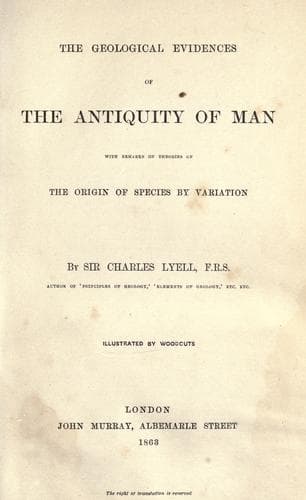
Evolution (Biology); Glacial epoch; Human beings -- Origin; Human evolution
In attempting to settle the chronology of fluviatile deposits, it is
almost equally difficult to avail ourselves of the evidence of organic
remains and of the superposition of the strata, for we may find two old
river-beds on the same level in juxtaposition, one of them perhaps
many thousands of years posterior in date to the other. I have seen an
example of this at Ilford, where the Thames, or a tributary stream, has
at some former period cut through sands containing Cyrena fluminalis,
and again filled up the channel with argillaceous matter, evidently
derived from the waste of the Tertiary London Clay. Such shiftings
of the site of the main channel of the river, the frequent removal
of gravel and sand previously deposited, and the throwing down of new
alluvium, the flooding of tributaries, the rising and sinking of the
land, fluctuations in the cold and heat of the climate--all these
changes seem to have given rise to that complexity in the fluviatile
deposits of the Thames, which accounts for the small progress we have
hitherto made in determining their order of succession, and that of
the imbedded groups of quadrupeds. It may happen, as at Brentford and
Ilford, that sand-pits in two adjoining fields may each contain distinct
species of elephant and rhinoceros; and the fossil remains in both
cases may occur at the same depth from the surface, yet may be severally
referable to different parts of the Pleistocene epoch, separated by
thousands of years.
The relation of the glacial period to alluvial deposits, such as that of
Gray's Thurrock, where the Cyrena fluminalis, Unio littoralis, and the
hippopotamus seem rather to imply a warmer climate, has been a matter
of long and animated discussion. Patches of the northern drift,
at elevations of about 200 feet above the Thames, occur in the
neighbourhood of London, as at Muswell Hill, near Highgate. In this
drift, blocks of granite, syenite, greenstone, Coal-measure sandstone
with its fossils, and other Palaeozoic rocks, and the wreck of Chalk and
Oolite, occur confusedly mixed together. The same glacial formation
is also found capping some of the Essex hills farther to the east, and
extending some way down their southern slopes towards the valley of
the Thames. Although no fragments washed out of these older and upland
drifts have been found in the gravel of the Thames containing elephants'
bones, it is fair to presume, as Mr. Prestwich has contended,* that the
glacial formation is the older of the two.
(* Prestwich, "Quarterly Journal of the Geological Society"
volume 11 1855 page 110; ibid. volume 12 1856 page 133;
ibid. volume 17 1861 page 446.)
In short, we must suppose that the basin of the Thames and all its
fluviatile deposits are post-glacial, in the modified sense of that
term; i.e. that they were subsequent to the drift of the central and
northern counties.
Public-domain text, read in full here on John Shaqi.
Reviews
Reviews
No reviews yet
Be the first to share your thoughts on this work.
Elsewhere in the archive
Join the Discussion
Join the discussion
Sign in to leave a comment or review.
Sign InorCreate an account