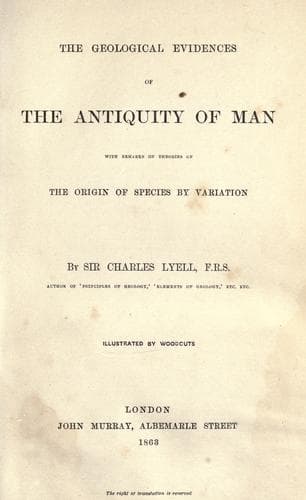
Evolution (Biology); Glacial epoch; Human beings -- Origin; Human evolution
I learn from Captain Spratt, R.N., that the island of Crete or Candia,
about 135 miles in length, has been raised at its western extremity
about 25 feet; so that ancient ports are now high and dry above the sea,
while at its eastern end it has sunk so much that the ruins of old towns
are seen under water. Revolutions like these in the physical geography
of the countries bordering the Mediterranean, may well help us to
understand the phenomena of the Palermo caves, and the presence in
Sicily of African species of mammalia.
CLIMATE AND HABITS OF THE HIPPOPOTAMUS.
As I have alluded more than once in this chapter to the occurrence of
the remains of the hippopotamus in places where there are now no rivers,
not even a rill of water, and as other bones of the same genus have been
met with in the lower-level gravels of the Somme where large blocks
of sandstone seem to imply that ice once played a part in their
transportation, it may be well to consider, before proceeding farther,
what geographical and climatal conditions are indicated by the presence
of these fossil pachyderms.
It is now very generally conceded that the mammoth and tichorhine
rhinoceros were fitted to inhabit northern regions, and it is therefore
natural to begin by asking whether the extinct hippopotamus may not
in like manner have flourished in a cold climate. In answer to this
inquiry, it has been remarked that the living hippopotami, anatomically
speaking so closely allied to the extinct species, are so aquatic and
fluviatile in their habits as to make it difficult to conceive that
their congeners could have thriven all the year round in regions where,
during winter, the rivers were frozen over for months. Moreover, I have
been unable to learn that, in any instance, bones of the hippopotamus
have been found in the drift of northern Germany associated with the
remains of the mammoth, tichorhine rhinoceros, musk-ox, reindeer,
lemming, and other arctic quadrupeds before alluded to; yet, though not
proved to have ever made a part of such a fauna, the presence of the
fossil hippopotamus north of the fiftieth parallel of latitude naturally
tempts us to speculate on the migratory powers and instincts of some
of the extinct species of the genus. They may have resembled, in this
respect, the living musk-ox, herds of which pass for hundreds of miles
over the ice to the rich pastures of Melville Island, and then return
again to southern latitudes before the ice breaks up.
We are indebted to Sir Andrew Smith,* an experienced zoologist, for
having given us an account of the migratory habits of the living
hippopotamus of Southern Africa (H. amphibius, Linn.).
(* "Illustrations of the Zoology of South Africa": article
"Hippopotamus.")
Public-domain text, read in full here on John Shaqi.
Reviews
Reviews
No reviews yet
Be the first to share your thoughts on this work.
Elsewhere in the archive
Join the Discussion
Join the discussion
Sign in to leave a comment or review.
Sign InorCreate an account