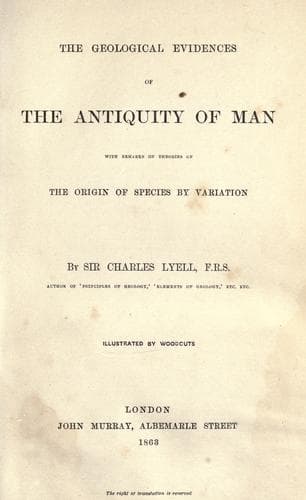
Evolution (Biology); Glacial epoch; Human beings -- Origin; Human evolution
"Beneath his head the hatchet hide,
That he so stoutly swung;
And place the bear's fat haunch beside--
The journey hence is long!
"And let the knife new sharpened be
That on the battle-day
Shore with quick strokes--he took but three--
The foeman's scalp away!
"The paints that warriors love to use,
Place here within his hand,
That he may shine with ruddy hues
Amidst the spirit-land."
(* "Poems and Ballads of Schiller.")
If we accept M. Lartet's interpretation of the ossiferous deposits of
Aurignac, both inside and outside the grotto, they add nothing to the
palaeontological evidence in favour of Man's antiquity, for we have seen
all the same mammalia associated elsewhere with flint implements, and
some species, such as the Elephas antiquus, Rhinoceros hemitoechus, and
Hippopotamus major, missing here, have been met with in other places. An
argument, however, having an opposite leaning may perhaps be founded on
the phenomena of Aurignac. It may--indeed it has been said, that they
imply that some of the extinct mammalia survived nearly to our times:
First--Because of the modern style of the works of art at Aurignac.
Secondly--Because of the absence of any signs of change in the physical
geography of the country since the cave was used for a place of
sepulture.
In reference to the first of these propositions, the utensils, it is
said, of bone and stone indicate a more advanced state of the arts than
the flint implements of Abbeville and Amiens. M. Lartet, however, is
of opinion that they do not, and thinks that we have no right to assume
that the fabricators of the various spear-headed and other tools of
the Valley of the Somme possessed no bone instruments or ornaments
resembling those discovered at Aurignac. These last, moreover, he
regards as extremely rude in comparison with others of the stone period
in France, which can be proved palaeontologically, at least by strong
negative evidence, to be of subsequent date. Thus, for example, at
Savigne, near Civray, in the department of Vienne, there is a cave in
which there are no extinct mammalia, but where remains of the reindeer
abound. The works of art of the stone period found there indicate
considerable progress in skill beyond that attested by the objects found
in the Aurignac grotto. Among the Savigne articles, there is the bone of
a stag, on which figures of two animals, apparently meant for deer, are
engraved in outline, as if by a sharp-pointed flint. In another cave,
that of Massat, in the department of Ariege, which M. Lartet ascribes
to the period of the aurochs, a quadruped which survived the reindeer in
the south of France, there are bone instruments of a still more advanced
state of the arts, as, for example, barbed arrows with a small canal in
each, believed to have served for the insertion of poison; also a needle
of bird's bone, finely shaped, with an eye or perforation at one end,
Public-domain text, read in full here on John Shaqi.
Reviews
Reviews
No reviews yet
Be the first to share your thoughts on this work.
Elsewhere in the archive
Join the Discussion
Join the discussion
Sign in to leave a comment or review.
Sign InorCreate an account