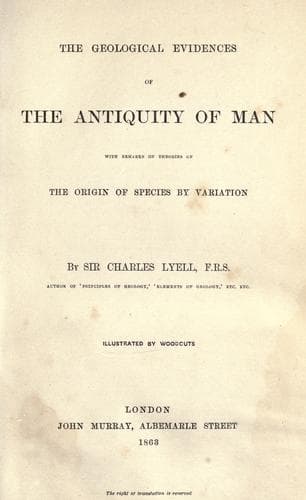
Evolution (Biology); Glacial epoch; Human beings -- Origin; Human evolution
It is important to dwell on this point, because some geologists have
felt disinclined to believe in the genuineness of the "fossil man of
Denise," on the ground that, if conceded, it would imply that the
human race was contemporary with an older fauna, or that of the Elephas
meridionalis. Such a fauna is found fossil in another layer of tuff
covering the slope of Denise, opposite to that where the museum specimen
was exhumed. The quadrupeds obtained from that more ancient tuff
comprise Elephas meridionalis, Hippopotamus major, Rhinoceros
megarhinus, Antilope torticornis, Hyaena brevirostris, and twelve others
of the genera horse, ox, stag, goat, tiger, etc., all supposed to be of
extinct species. This tuff, found between Malouteyre and Polignac, M.
Robert regards as the product of a much older eruption, and referable to
the neighbouring Montagne de St. Anne, a volcano in a much more wasted
and denuded state than Denise, and classed by M. Bertrand de Doue as of
intermediate age between the ancient and modern cones of Velay.
The fauna to which Elephas meridionalis and its associates belong, can
be shown to be of anterior date, in the north of France, to the flint
implements of St. Acheul, by the following train of reasoning. The
valley of the Seine is not only geographically contiguous to the valley
of the Somme, but its ancient alluvium contains the same mammoth and
other fossil species. The Eure, one of the tributaries of the Seine, in
its way to join that river, flows in a valley which follows a line of
fault in the Chalk; and this valley is seen to be comparatively modern,
because it intersects at St. Prest, 4 miles below Chartres, an older
valley belonging to an anterior system of drainage, which has been
filled by a more ancient fluviatile alluvium, consisting of sand and
gravel, 90 feet thick. I have examined the site of this older drift, and
the fossils have been determined by Dr. Falconer. They comprise Elephas
meridionalis, a species of rhinoceros (not R. tichorhinus), and other
mammalia differing from those of the implement-bearing gravels of the
Seine and Somme. The latter, belonging to the period of the mammoth,
might very well have been contemporary with the modern volcanic
eruptions of Central France; and we may presume, even without the aid of
the Denise fossil, that Man may have witnessed these. But the tuffs and
gravels in which the Elephas meridionalis are embedded were synchronous
with an older epoch of volcanic action, to which the cone of St. Anne,
near Le Puy, and many other mountains of M. Bertrand de Doue's middle
period belong, having cones and craters, which have undergone much
waste by aqueous erosion. We have as yet no proof that Man witnessed
the origin of these hills of lava and scoriae of the middle phase of
volcanic action.
Public-domain text, read in full here on John Shaqi.
Reviews
Reviews
No reviews yet
Be the first to share your thoughts on this work.
Elsewhere in the archive
Join the Discussion
Join the discussion
Sign in to leave a comment or review.
Sign InorCreate an account