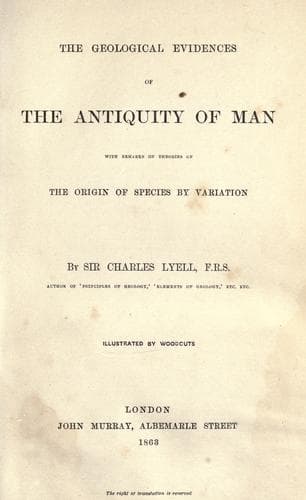
Evolution (Biology); Glacial epoch; Human beings -- Origin; Human evolution
Owing to the destructible nature of the yellow loam, d e, Figure 26,
every streamlet flowing over the platform has cut for itself, in its way
to the Mississippi, a deep gully or ravine; and this erosion has of
late years, especially since 1812, proceeded with accelerated speed,
ascribable in some degree to the partial clearing of the native forest,
but partly also to the effects of the earthquake of 1811-12. By
that convulsion the region around Natchez was rudely shaken and much
fissured. One of the narrow valleys near Natchez, due to this fissuring,
is now called the Mammoth Ravine. Though no less than 7 miles long,
and in some parts 60 feet deep, I was assured by a resident proprietor,
Colonel Wiley, that it had no existence before 1812. With its numerous
ramifications, it is said to have been entirely formed since the
earthquake at New Madrid. Before that event, Colonel Wiley had ploughed
some of the land exactly over a spot now traversed by part of this
water-course.
I satisfied myself that the ravine had been considerably enlarged
and lengthened a short time before my visit, and it was then freshly
undermined and undergoing constant waste. From a clayey deposit
immediately below the yellow loam, bones of the Mastodon ohioticus, a
species of Megalonyx, bones of the genera Equus, Bos, and others,
some of extinct and others presumed to be of living species, had been
detached, and had fallen to the base of the cliffs. Mingled with the
rest, the pelvic bone of a man, os innominatum, was obtained by Dr.
Dickeson of Natchez, in whose collection I saw it. It appeared to be
quite in the same state of preservation, and was of the same black
colour as the other fossils, and was believed to have come like them
from a depth of about 30 feet from the surface. In my "Second Visit
to America," in 1846, I suggested, as a possible explanation of this
association of a human bone with remains of Mastodon and Megalonyx, that
the former may possibly have been derived from the vegetable soil at the
top of the cliff, whereas the remains of extinct mammalia were dislodged
from a lower position, and both may have fallen into the same heap or
talus at the bottom of the ravine. The pelvic bone might, I conceived,
have acquired its black colour by having lain for years or centuries
in a dark superficial peaty soil, common in that region. I was informed
that there were many human bones, in old Indian graves in the same
district, stained of as black a dye. On suggesting this hypothesis
to Colonel Wiley of Natchez, I found that the same idea had already
occurred to his mind. No doubt, had the pelvic bone belonged to any
recent mammifer other than Man, such a theory would never have been
resorted to; but so long as we have only one isolated case, and are
without the testimony of a geologist who was present to behold the bone
when still engaged in the matrix, and to extract it with his own hands,
it is allowable to suspend our judgment as to the high antiquity of the
Public-domain text, read in full here on John Shaqi.
Reviews
Reviews
No reviews yet
Be the first to share your thoughts on this work.
Elsewhere in the archive
Join the Discussion
Join the discussion
Sign in to leave a comment or review.
Sign InorCreate an account