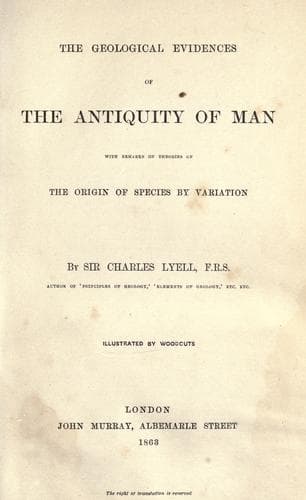
Evolution (Biology); Glacial epoch; Human beings -- Origin; Human evolution
We are called upon, then, to explain how any force can have been exerted
against the upper masses, so as to produce movements in which the
subjacent strata have not participated. It may be answered that, if we
conceive the till and its boulders to have been drifted to their
present place by ice, the lateral pressure may have been supplied by
the stranding of ice-islands. We learn, from the observations of Messrs.
Dease and Simpson in the polar regions, that such islands, when they
run aground, push before them large mounds of shingle and sand. It
is therefore probable that they often cause great alterations in the
arrangement of pliant and incoherent strata forming the upper part of
shoals or submerged banks, the inferior portions of the same remaining
unmoved. Or many of the complicated curvatures of these layers of loose
sand and gravel may have been due to another cause, the melting on the
spot of ice-bergs and coast ice in which successive deposits of pebbles,
sand, ice, snow, and mud, together with huge masses of rock fallen from
cliffs, may have become interstratified. Ice-islands so constituted
often capsize when afloat, and gravel once horizontal may have assumed,
before the associated ice was melted, an inclined or vertical
position. The packing of ice forced up on a coast may lead to a similar
derangement in a frozen conglomerate of sand or shingle, and, as Mr.
Trimmer has suggested,* alternate layers of earthy matter may have sunk
down slowly during the liquefaction of the intercalated ice so as to
assume the most fantastic and anomalous positions, while the strata
below, and those afterwards thrown down above, may be perfectly
horizontal (see above).
(* "Quarterly Journal of the Geological Society" volume 7
1851 pages 22, 30.)
In most cases where the principal contortions of the layers of gravel
and sand have a decided correspondence with deep indentations in the
underlying till, the hypothesis of the melting of large lumps and masses
of ice once mixed up with the till affords the most natural explanation
of the phenomena. The quantity of ice now seen in the cliffs near
Behring's Straits, in which the remains of fossil elephants are common,
and the huge fragments of solid ice which Meyendorf discovered in
Siberia, after piercing through a considerable thickness of incumbent
soil, free from ice, is in favour of such an hypothesis, the partial
failure of support necessarily giving rise to foldings in the overlying
and previously horizontal layers, as in the case of creeps in coal
mines.*
(* See "Manual of Geology" by the author, page 51.)
Public-domain text, read in full here on John Shaqi.
Reviews
Reviews
No reviews yet
Be the first to share your thoughts on this work.
Elsewhere in the archive
Join the Discussion
Join the discussion
Sign in to leave a comment or review.
Sign InorCreate an account