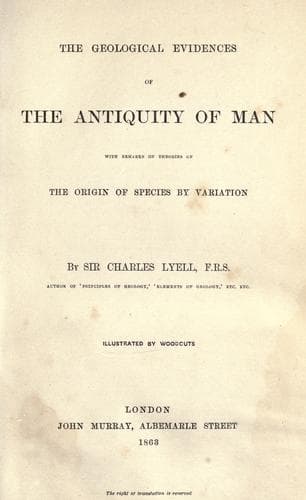
Evolution (Biology); Glacial epoch; Human beings -- Origin; Human evolution
In order fully to discuss this question, I must begin by referring
to some of the newest theoretical opinions entertained on the glacial
question. When treating of this subject in the "Principles of Geology,"
chapter 15, and in the "Manual (or Elements) of Geology," chapter 11, I
have stated that the whole mass of the ice in a glacier is in constant
motion, and that the blocks of stone detached from boundary precipices,
and the mud and sand swept down by avalanches of snow, or by rain from
the surrounding heights, are lodged upon the surface and slowly borne
along in lengthened mounds, called in Switzerland moraines. These
accumulations of rocky fragments and detrital matter are left at the
termination of the glacier, where it melts in a confused heap called the
"terminal moraine," which is unstratified, because all the blocks, large
and small, as well as the sand and the finest mud, are carried to
equal distances and quietly deposited in a confused mass without being
subjected to the sorting power of running water, which would convey the
finer materials farther than the coarser ones, and would produce, as the
strength of the current varied from time to time in the same place, a
stratified arrangement.
In those regions where glaciers reach the sea, and where large masses of
ice break off and float away, moraines, such as I have just alluded to,
may be transported to indefinite distances, and may be deposited on the
bottom of the sea wherever the ice happens to melt. If the liquefaction
take place when the berg has run aground and is stationary, and if there
be no current, the heap of angular and rounded stones, mixed with sand
and mud, may fall to the bottom in an unstratified form called "till" in
Scotland, and which has been shown in the last chapter to abound in the
Norfolk cliffs; but should the action of a current intervene at certain
points or at certain seasons, then the materials will be sorted as they
fall, and arranged in layers according to their relative weight and
size. Hence there will be passages from till to stratified clay, gravel,
and sand.
Some of the blocks of stone with which the surfaces of glaciers are
loaded, falling occasionally through fissures in the ice, get fixed and
frozen into the bottom of the moving mass, and are pushed along under
it. In this position, being subjected to great pressure, they scoop
out long rectilinear furrows or grooves parallel to each other on the
subjacent solid rock. Smaller scratches and striae are made on the
polished surface by crystals or projecting edges of the hardest
minerals, just as a diamond cuts glass.
Public-domain text, read in full here on John Shaqi.
Reviews
Reviews
No reviews yet
Be the first to share your thoughts on this work.
Elsewhere in the archive
Join the Discussion
Join the discussion
Sign in to leave a comment or review.
Sign InorCreate an account