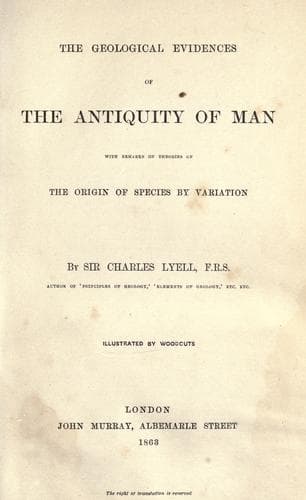
Evolution (Biology); Glacial epoch; Human beings -- Origin; Human evolution
Another argument is also adduced by him in proof of the ice having
exerted its mechanical force in a direction from the higher and more
inland country to the lower region and sea-coast. Isolated hills and
minor prominences of rock are often polished and striated on the land
side, while they remain rough and jagged on the side fronting the sea.
This may be seen both on the east and west coast. Mention is also
made of blocks of granite which have travelled from south to north
in Aberdeenshire, of which there would have been no examples had the
erratics been all brought by floating ice from the arctic regions
when Scotland was submerged. It is also urged against the doctrine of
attributing the general glaciation to submergence, that the glacial
grooves, instead of radiating as they do from a centre, would, if they
had been due to ice coming from the north, have been parallel to the
coast-line, to which they are now often almost at right angles. The
argument, moreover, which formerly had most weight in favour of floating
ice, namely, that it explained why so many of the stones did not conform
to the contour and direction of the minor hills and valleys, is now
brought forward, and with no small effect, in favour of the doctrine of
continental ice on the Greenlandic scale, which, after levelling up the
lesser inequalities, would occasionally flow in mighty ice-currents, in
directions often at a high angle to the smaller ridges and glens.
The application to Scandinavia and Scotland of this theory makes it
necessary to reconsider the validity of the proofs formerly relied on
as establishing the submergence of a great part of Scotland beneath
the sea, at some period subsequent to the commencement of the glacial
period. In all cases where marine shells overlie till, or rest on
polished and striated surfaces of rock, the evidence of the land having
been under water, and having been since upheaved, remains unshaken; but
this special proof rarely extends to heights exceeding 500 feet. In the
basin of the Clyde we have already seen that Recent strata occur 25 feet
above the sea-level, with existing species of marine testacea, and with
buried canoes, and other works of art. At the higher level of 50
feet occurs the well-known raised beach of the western coast, which,
according to Mr. Jamieson, contains, near Fort William and on Loch Fyne
and elsewhere, an assemblage of shells implying a colder climate than
that of the 25-foot terrace, or that of the present sea; just as, in the
valley of the Somme, the higher-level gravels are supposed to belong to
a colder period than the lower ones, and still more decidedly than that
of the present era. At still greater elevations, older beds containing
a still more arctic group of shells have been observed at Airdrie, 14
miles south-east of Glasgow, 524 feet above the level of the sea. They
were embedded in stratified clays, with the unstratified boulder till
Public-domain text, read in full here on John Shaqi.
Reviews
Reviews
No reviews yet
Be the first to share your thoughts on this work.
Elsewhere in the archive
Join the Discussion
Join the discussion
Sign in to leave a comment or review.
Sign InorCreate an account