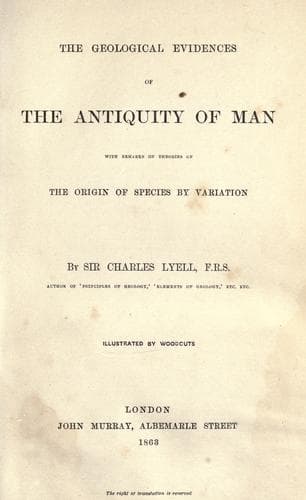
Evolution (Biology); Glacial epoch; Human beings -- Origin; Human evolution
Mr. Jamieson, when he first gave an account of this drift, inferred, in
spite of the absence of marine shells, that it implied the submergence
of Scotland beneath the ocean after the commencement of the glacial
period, or after the era of continental ice indicated by the subjacent
floor of polished and grooved rock. This conclusion would require
a submergence of the land as far up as 1550 feet above the present
sea-level, after which a great re-upheaval must have occurred. But the
same author, having lately revisited the valley of the Tummel, suggests
another possible, and I think probable, explanation of the same
phenomena. The stratified drift in question is situated in a deep
depression between two buttresses of rock, and if an enormous glacier be
supposed to have once filled the valley of the Tummel to the height
of the stratified drift, it may have dammed up the mouth of a mountain
torrent by a transverse barrier, giving rise to a deep pond, in which
beds of clay and sand brought down by the waters of the torrent were
deposited. Charpentier in his work on the Swiss glaciers has described
many such receptacles of stratified matter now in progress, and due
to such blockages, and he has pointed out the remnants of ancient and
similar formations left by extinct glaciers of an earlier epoch. He
specially notices that angular stones of various dimensions, often
polished and striated, which rest on the glacier and are let fall when
the torrent undermines the side of the moving ice, descend into the
small lake and become interstratified with the gravel and fine sediment
brought down by the torrent into the same.*
(* Charpentier, "Essai sur les Glaciers" page 63 1841.)
The evidence of the former sojourn of the sea upon the land after the
commencement of the glacial period was formerly inferred from the height
to which erratic blocks derived from distant regions could be traced,
besides the want of conformity in the glacial furrows to the present
contours of many of the valleys. Some of these phenomena may now, as we
have seen, be accounted for by assuming that there was once a crust of
ice resembling that now covering Greenland.
The Grampians in Forfarshire and in Perthshire are from 3000 to
4000 feet high. To the southward lies the broad and deep valley of
Strathmore, and to the south of this again rise the Sidlaw Hills to the
height of 1500 feet and upwards. On the highest summits of this chain,
formed of sandstone and shale, and at various elevations, I have
observed huge angular fragments of mica-schist, some 3 and others 15
feet in diameter, which have been conveyed for a distance of at least
15 miles from the nearest Grampian rocks from which they could have been
detached. Others have been left strewed over the bottom of the large
intervening vale of Strathmore.*
(* "Proceedings of the Geological Society" volume 3 page
344.)
Public-domain text, read in full here on John Shaqi.
Reviews
Reviews
No reviews yet
Be the first to share your thoughts on this work.
Elsewhere in the archive
Join the Discussion
Join the discussion
Sign in to leave a comment or review.
Sign InorCreate an account