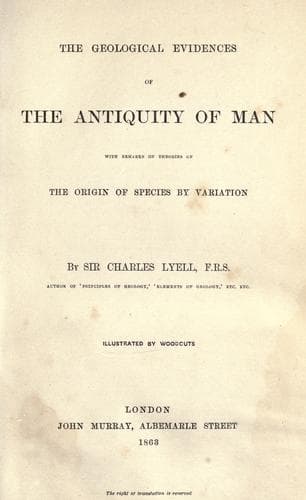
Evolution (Biology); Glacial epoch; Human beings -- Origin; Human evolution
Whether the horizontality of the shelves or terrace-lines is really as
perfect as has been generally assumed is a point which will require to
be tested by a more accurate trigonometrical survey than has yet been
made. The preservation of precisely the same level in the lowest line
throughout the glens of Roy, Spean, and Laggan, for a distance of 20
miles east and west, and 10 or 12 miles north and south, would be very
wonderful if ascertained with mathematical precision. Mr. Jamieson,
after making in 1862 several measurements with a spirit-level, has been
led to suspect a rise in the lowest shelf of one foot in a mile in a
direction from west to east, or from the mouth of Glen Roy to a point
6 miles east of it in Glen Spean. To confirm such observations, and to
determine whether a similar rate of rise continues eastward, as far as
the pass of Muckul, would be most important.
On the whole, I conclude that the Glen Roy terrace-lines and those of
some neighbouring valleys, were formed on the borders of glacier-lakes,
in times long subsequent to the principal glaciation of Scotland. They
may perhaps have been nearly as late, especially the lowest of the
shelves, as that portion of the Pleistocene period in which Man
co-existed in Europe with the mammoth.
CHAPTER 14. -- CHRONOLOGICAL RELATIONS OF THE GLACIAL PERIOD AND THE
EARLIEST SIGNS OF MAN'S APPEARANCE IN EUROPE--CONTINUED.
Signs of extinct Glaciers in Wales.
Great Submergence of Wales during the Glacial Period proved by
Marine Shells.
Still greater Depression inferred from Stratified Drift.
Scarcity of Organic Remains in Glacial Formations.
Signs of extinct Glaciers in England.
Ice Action in Ireland.
Maps illustrating successive Revolutions in Physical Geography
during the Pleistocene Period.
Southernmost Extent of Erratics in England.
Successive Periods of Junction and Separation of England, Ireland,
and the Continent.
Time required for these Changes.
Probable Causes of the Upheaval and Subsidence of the Earth's Crust.
Antiquity of Man considered in relation to the Age of the existing
Fauna and Flora.
EXTINCT GLACIERS IN WALES.
The considerable amount of vertical movement in opposite directions,
which was suggested in the last chapter, as affording the most probable
explanation of the position of some of the stratified and fossiliferous
drifts of Scotland, formed since the commencement of the glacial
period, will appear less startling if it can be shown that independent
observations lead us to infer that a geographical revolution of still
greater magnitude accompanied the successive phases of glaciation
through which the Welsh mountains have passed.
Public-domain text, read in full here on John Shaqi.
Reviews
Reviews
No reviews yet
Be the first to share your thoughts on this work.
Elsewhere in the archive
Join the Discussion
Join the discussion
Sign in to leave a comment or review.
Sign InorCreate an account