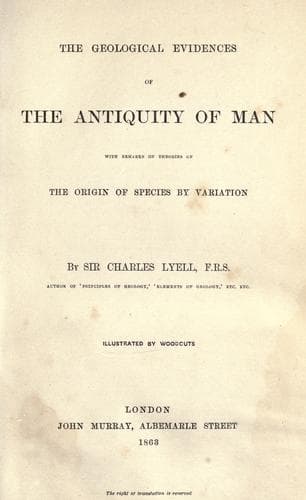
Evolution (Biology); Glacial epoch; Human beings -- Origin; Human evolution
He pointed out that the surface of every large glacier is strewed over
with gravel and stones detached from the surrounding precipices by
frost, rain, lightning, or avalanches. And he described more carefully
than preceding writers the long lines of these stones, which settle on
the sides of the glacier, and are called the lateral moraines; those
found at the lower end of the ice being called terminal moraines.
Such heaps of earth and boulders every glacier pushes before it when
advancing, and leaves behind it when retreating. When the Alpine glacier
reaches a lower and a warmer situation, about 3000 or 4000 feet above
the sea, it melts so rapidly that, in spite of the downward movement
of the mass, it can advance no farther. Its precise limits are variable
from year to year, and still more so from century to century; one
example being on record of a recession of half a mile in a single year.
We also learn from M. Venetz, that whereas, between the eleventh and
fifteenth centuries, all the Alpine glaciers were less advanced than
now, they began in the seventeenth and eighteenth centuries to push
forward, so as to cover roads formerly open, and to overwhelm forests of
ancient growth.
These oscillations enable the geologist to note the marks which a
glacier leaves behind it as it retrogrades; and among these the most
prominent, as before stated, are the terminal moraines, or mounds of
unstratified earth and stones, often divided by subsequent floods into
hillocks, which cross the valley like ancient earthworks, or embankments
made to dam up a river. Some of these transverse barriers were formerly
pointed out by Saussure below the glacier of the Rhone, as proving how
far it had once transgressed its present boundaries. On these moraines
we see many large angular fragments, which, having been carried along
the surface of the ice, have not had their edges worn off by friction;
but the greater number of the boulders, even those of large size, have
been well rounded, not by the power of water, but by the mechanical
force of the ice, which has pushed them against each other, or against
the rocks flanking the valley. Others have fallen down the numerous
fissures which intersect the glacier, where, being subject to the
pressure of the whole mass of ice, they have been forced along, and
either well rounded or ground down into sand, or even the finest mud, of
which the moraine is largely constituted.
Public-domain text, read in full here on John Shaqi.
Reviews
Reviews
No reviews yet
Be the first to share your thoughts on this work.
Elsewhere in the archive
Join the Discussion
Join the discussion
Sign in to leave a comment or review.
Sign InorCreate an account