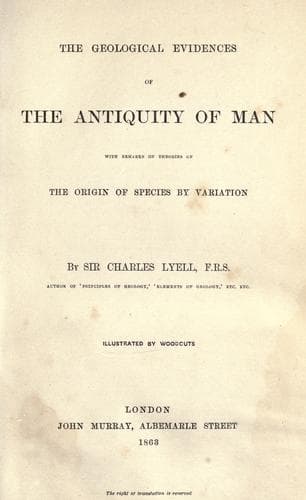
Evolution (Biology); Glacial epoch; Human beings -- Origin; Human evolution
To return to the marks of glaciation: in the moraine at Mazze there are
many large blocks of protogine and large and small ones of limestone
and serpentine which have been brought down from Monte Rosa, through
the gorge of Ivrea, after having travelled for a distance of 50
miles. Confining my attention to a part of the moraine where pieces of
limestone and serpentine were very numerous, I found that no less than
one-third of the whole number bore unequivocal signs of glacial action;
a state of things which seems to bear some relation to the vast volume
and pressure of the ice which once constituted the extinct glacier and
to the distance which the stones had travelled. When I separated the
pebbles of quartz, which were never striated, and those of granite,
mica-schist, and diorite, which do not often exhibit glacial markings,
and confined my attention to the serpentine alone I found no less than
nineteen in twenty of the whole number polished and scratched; whereas
in the terminal moraines of some modern glaciers, where the materials
have travelled not more than 10 or 15, instead of 100 miles, scarce
one in twenty even of the serpentine pebbles exhibit glacial polish and
striation.
THEORY OF THE ORIGIN OF LAKE-BASINS BY THE EROSIVE ACTION OF GLACIERS,
CONSIDERED.
Geologists are all agreed that the last series of movements to which the
Alps owe their present form and internal structure occurred after the
deposition of the Miocene strata; and it has been usual to refer the
origin of the numerous lake-basins of Alpine and sub-Alpine regions both
in Switzerland and Northern Italy to the same movements; for it
seemed not unnatural to suppose, that forces capable of modifying the
configuration of the greatest European chain, by uplifting some of its
component Tertiary strata (those of marine origin of the Miocene period)
several thousand feet above their former level, after throwing them
into vertical and contorted positions, must also have given rise to many
superficial inequalities, in some of which large bodies of water would
collect. M. Desor, in a memoir on the Swiss and Italian lakes, suggested
that they may have escaped being obliterated by sedimentary deposition
by having been filled with ice during the whole of the glacial period.
Subsequently to the retreat of the great glaciers we know that the
lake-basins have been to a certain extent encroached upon and turned
into land by river deltas; one of which, that of the Rhone at the head
of the Lake of Geneva, is no less than 12 miles long and several miles
broad, besides which there are many torrents on the borders of the same
lake, forming smaller deltas.
Public-domain text, read in full here on John Shaqi.
Reviews
Reviews
No reviews yet
Be the first to share your thoughts on this work.
Elsewhere in the archive
Join the Discussion
Join the discussion
Sign in to leave a comment or review.
Sign InorCreate an account