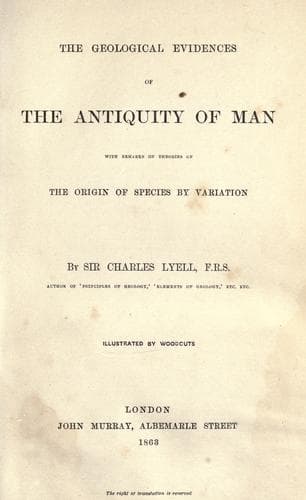
Evolution (Biology); Glacial epoch; Human beings -- Origin; Human evolution
The first of them, that of Utznach, is a delta formed at the head of
the ancient and once more extensive lake. The argillaceous and
lignite-bearing strata, more than 100 feet in thickness, rest
unconformably on highly inclined and sometimes vertical Miocene molasse.
These clays are covered conformably by stratified sand and gravel 60
feet thick, partly consolidated, in which the pebbles are of rocks
belonging to the upper valleys of the Limmat and its tributaries, all
of them small and not glacially striated and wholly without admixture
of large angular stones. On the top of all repose very large erratic
blocks, affording clear evidence that the colossal glacier which once
filled the valley of the Limmat covered the old littoral deposit. The
great age of the lignite is partly indicated by the bones of Elephas
antiquus found in it.
I visited Utznach in company with M. Escher von der Linth in 1857, and
during the same year examined the lignite of Durnten, many miles farther
down on the right bank of the lake, in company with Professor Heer and
M. Marcou. The beds there are of the same age and within a few feet of
the same height above the level of the lake. They might easily have
been overlooked or confounded with the general glacial drift of the
neighbourhood, had not the bed of lignite, which is from 5 to 12 feet
thick, been worked for fuel, during which operation many organic remains
came to light. Among these are the teeth of Elephas antiquus, determined
by Dr. Falconer, and Rhinoceros leptorhinus? (R. megarhinus, Christol),
the wild bull and red deer (Bos primigenius, Boj., and Cervus elaphus,
L.), the last two determined by Professor Rutimeyer. In the same beds I
found many freshwater shells of the genera Paludina, Limnaea, etc., all
of living species. The plants named by Professor Heer are also Recent
and agree singularly with those of the Cromer buried forest, before
described.
Among them are the Scotch and spruce firs, Pinus sylvestris and Pinus
abies, and the buckbean, or Menyanthes trifoliata, etc., besides the
common birch and other European plants.
Overlying this lignite are first, as at Utznach, stratified gravel not
of glacial origin, about 30 feet thick; and secondly, highest of all,
huge angular erratic blocks clearly indicating the presence of a great
glacier posterior in date to all the organic remains above enumerated.
If any one of the existing Swiss lakes were now lowered by deepening its
outlet, or by raising the higher portion of it relatively to the lower,
we should see similar deltas of comparatively modern date exposed to
view, some of them with embedded trunks of pines of the same species
drifted down during freshets. Such deposits would be most frequent at
the upper ends of the lakes, but a few would occur on either bank not
far from the shore where torrents once entered, agreeing in geographical
position with the lignite formations of Utznach and Durnten.
Public-domain text, read in full here on John Shaqi.
Reviews
Reviews
No reviews yet
Be the first to share your thoughts on this work.
Elsewhere in the archive
Join the Discussion
Join the discussion
Sign in to leave a comment or review.
Sign InorCreate an account