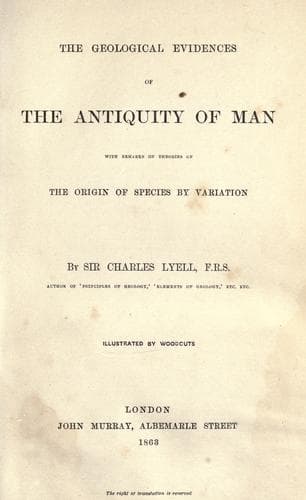
Evolution (Biology); Glacial epoch; Human beings -- Origin; Human evolution
a thousand centuries the glacier melts, a large and deep basin
representing the difference in the movement of two adjoining mountain
areas--namely, the central and the circumferential--is for the first
time rendered visible.
By adopting this hypothesis, we concede that there is an intimate
connection between the glacial period and a predominance of lakes, in
producing which the action of ice is threefold; first, by its direct
power in scooping out shallow basins where the rocks are of unequal
hardness; an operation which can by no means be confined to the land,
for it must extend to below the level of high water a thousand feet
and more in such fjords as have been described as filled with ice in
Greenland.
Secondly. The ice will act indirectly by preventing cavities caused by
inequalities of subsidence or elevation from becoming the receptacles
first of water and then of sediment, by which the cavities would be
levelled up and the lakes obliterated.
Thirdly. The ice is also an indirect cause of lakes, by heaping up
mounds of moraine matter and thus giving rise to ponds and even to
sheets of water several miles in diameter.
The comparative scarcity, therefore, of lakes of Pleistocene date
in tropical countries, and very generally south of the fortieth and
fiftieth parallels of latitude, may be accounted for by the absence of
glacial action in such regions.
POST-GLACIAL LAKE-DWELLING IN THE NORTH OF ITALY.
We learn from M. de Mortillet that in the peat which has filled up one
of the "morainic lakes" formed by the ancient glacier of the Ticino, M.
Moro has discovered at Mercurago the piles of a lake-dwelling like those
of Switzerland, together with various utensils and a canoe hollowed out
of the trunk of a tree. From this fact we learn that south of the
Alps as well as north of them a primitive people having similar habits
flourished after the retreat of the great glaciers.
SUCCESSIVE PHASES OF GLACIAL ACTION IN THE ALPS, AND THEIR RELATION TO
THE HUMAN PERIOD [34].
According to the geological observations of M. Morlot, the following
successive phases in the development of ice-action in the Alps are
plainly recognisable:--
First. There was a period when the ice was in its greatest excess, when
the glacier of the Rhone not only reached the Jura, but climbed to the
height of 2015 feet above the Lake of Neufchatel, and 3450 feet above
the sea, at which time the Alpine ice actually entered the French
territory at some points, penetrating by certain gorges, as through the
defile of the Fort de l'Ecluse, among others.
Public-domain text, read in full here on John Shaqi.
Reviews
Reviews
No reviews yet
Be the first to share your thoughts on this work.
Elsewhere in the archive
Join the Discussion
Join the discussion
Sign in to leave a comment or review.
Sign InorCreate an account