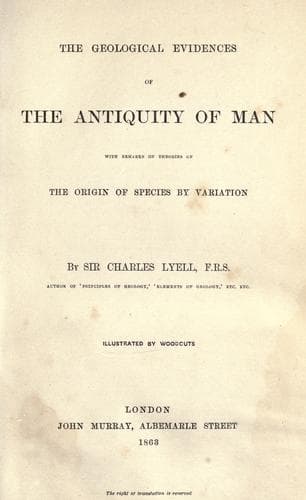
Evolution (Biology); Glacial epoch; Human beings -- Origin; Human evolution
This underlying gravel consists in the valley of the Rhine for the most
part of pebbles and boulders of Alpine origin, showing that there was a
time when the rivers had power to convey coarse materials for hundreds
of miles northwards from Switzerland towards the sea; whereas at a later
period an entire change was brought about in the physical geography of
the same district, so that the same river deposited nothing but fine
mud, which accumulated to a thickness of 800 feet or more above the
original alluvial plain.
But although most of the fundamental gravel was derived from the Alps,
there has been observed in the neighbourhood of the principal mountain
chains bordering the great valley, such as the Black Forest, Vosges,
and Odenwald, an admixture of detritus characteristic of those several
chains. We cannot doubt therefore that as some of these mountains,
especially the Vosges, had during the glacial period their own glaciers,
a part of the fine mud of their moraines must have been mingled with
loess of Alpine origin; although the principal mass of the latter must
have come from Switzerland, and can in fact be traced continuously from
Basle to Belgium.
GEOGRAPHICAL DISTRIBUTION OF THE LOESS.
It was stated in the last chapter that at the time of the greatest
extension of the Swiss glaciers the Lake of Constance and all the other
great lakes were filled with ice, so that gravel and mud could pass
freely from the upper Alpine valley of the Rhine to the lower region
between Basle and the sea, the great lake intercepting no part of the
moraines whether fine or coarse. On the other hand the Aar with its
great tributaries the Limmat and the Reuss does not join the Rhine till
after it issues from the Lake of Constance; and by their channels a
large part of the Alpine gravel and mud could always have passed without
obstruction into the lower country, even after the ice of the great lake
had melted.
Public-domain text, read in full here on John Shaqi.
Reviews
Reviews
No reviews yet
Be the first to share your thoughts on this work.
Elsewhere in the archive
Join the Discussion
Join the discussion
Sign in to leave a comment or review.
Sign InorCreate an account