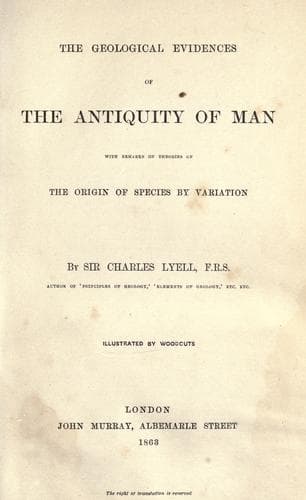
Evolution (Biology); Glacial epoch; Human beings -- Origin; Human evolution
As to the higher and lower level gravels of that valley, which, like
that of the Seine, contain no foreign rocks, we have seen that they are
each of them covered by deposits of loess or inundation-mud belonging
respectively to the periods of the gravels, whereas the upland loam is
of much older date, more widely spread, and occupying positions often
independent of the present lines of drainage. To restore in imagination
the geographical outline of Picardy, to which rivers charged with so
much homogeneous loam and running at such heights may once have belonged
is now impossible.*
(* See above, Chapter 8. )
In the valley of the Rhine, as I before observed, the body of the loess,
instead of having been formed at successively lower and lower levels as
in the case of the basin of the Somme, was deposited in a wide and deep
pre-existing basin, or strath, bounded by lofty mountain chains such
as the Black Forest, Vosges, and Odenwald. In some places the loam
accumulated to such a depth as first to fill the valley and then to
spread over the adjoining table-lands, as in the case of the Lower
Eifel, where it encircled some of the modern volcanic cones of loose
pumice and ashes. In these instances it does not appear to me that the
volcanoes were in eruption during the time of the deposition of the
loess, as some geologists have supposed. The interstratification of loam
and volcanic ejectamenta was probably occasioned by the fluviatile mud
having gradually enveloped the cones of loose scoriae after they were
completely formed. I am the more inclined to embrace this view after
having seen the junction of granite and loess on the steep slopes of
some of the mountains bounding the great plain of the Rhine on its
right bank in the Bergstrasse. Thus between Darmstadt and Heidelberg
perpendicular sections are seen of loess 200 feet thick, at various
heights above the river, some of them at elevations of 800 feet and
upwards. In one of these may be seen, resting on the hill side of
Melibocus in the Odenwald, the usual yellow loam free from pebbles at
its contact with a steep slope of granite, but divided into horizontal
layers for a short distance from the line of junction. In these layers,
which abut against the granite, a mixture of mica and of unrounded
grains of quartz and felspar occur, evidently derived from the
disintegration of the crystalline rock, which must have decomposed in
the atmosphere before the mud had reached this height. Entire shells of
Helix, Pupa, and Succinea, of the usual living species, are embedded in
the granitic mixture. We may therefore be sure that the valley bounded
by steep hills of granite existed before the tranquil accumulation of
this vast body of loess.
Public-domain text, read in full here on John Shaqi.
Reviews
Reviews
No reviews yet
Be the first to share your thoughts on this work.
Elsewhere in the archive
Join the Discussion
Join the discussion
Sign in to leave a comment or review.
Sign InorCreate an account