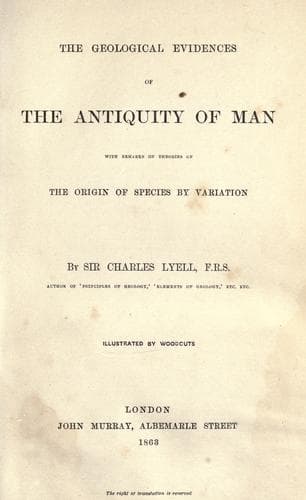
Evolution (Biology); Glacial epoch; Human beings -- Origin; Human evolution
Below the loess of Canstadt, in which bones of the mammoth are so
abundant, is a bed of gravel evidently an old river channel now many
feet above the level of the Neckar, the valley having there been
excavated to some depth below its ancient channel so as to lie in the
underlying red sandstone of Keuper. Although the loess, when traced from
the valley of the Rhine into that of the Neckar, or into any other
of its tributaries, often undergoes some slight alteration in its
character, yet there is so much identity of composition as to suggest
the idea that the mud of the main river passed far up the tributary
valleys, just as that of the Mississippi during floods flows far up the
Ohio, carrying its mud with it into the basin of that river. But
the uniformity of colour and mineral composition does not extend
indefinitely into the higher parts of every basin. In that of the
Neckar, for example, near Tubingen, I found the fluviatile loam or
brick-earth, enclosing the usual Helices and Succineae, together with
the bones of the mammoth, very distinct in colour and composition from
ordinary Rhenish loess, and such as no one could confound with Alpine
mud. It is mottled with red and green, like the New Red Sandstone or
Keuper, from which it has clearly been derived.
Such examples, however, merely show that where a basin is so limited
in size that the detritus is derived chiefly or exclusively from one
formation, the prevailing rock will impart its colour and composition
in a very decided manner to the loam; whereas, in the basin of a great
river which has many tributaries, the loam will consist of a mixture
of almost every variety of rock, and will therefore exhibit an average
result nearly the same in all countries. Thus, the loam which fills to
a great depth the wide valley of the Saone, which is bounded on the west
side by an escarpment of Inferior Oolite, and by the chain of the Jura
on the east, is very like the loess found in the continuation of the
same great basin after the junction of the Rhone, by which a large
supply of Alpine mud has been added and intermixed.
In the higher parts of the basin of the Danube, loess of the same
character as that of the Rhine, and which I believe to be chiefly of
Alpine origin, attains a far greater elevation above the sea than any
deposits of Rhenish loess; but the loam which, according to M. Stur,
fills valleys on the north slope of the Carpathians almost up to the
watershed between Galicia and Hungary, may be derived from a distinct
source.
OSCILLATIONS OF LEVEL REQUIRED TO EXPLAIN THE ACCUMULATION AND
DENUDATION OF THE LOESS.
Public-domain text, read in full here on John Shaqi.
Reviews
Reviews
No reviews yet
Be the first to share your thoughts on this work.
Elsewhere in the archive
Join the Discussion
Join the discussion
Sign in to leave a comment or review.
Sign InorCreate an account