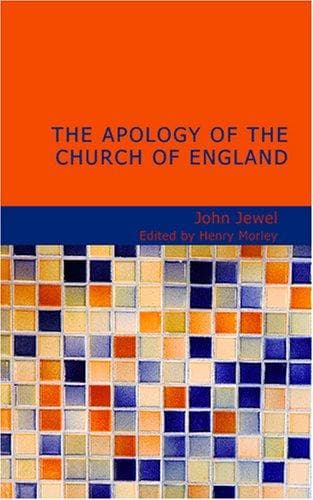
Anglican Communion -- Apologetic works; Church of England -- Apologetic works
Full well know they that nothing is more in the people's favour, or
better liketh the common sort, than these names. But how if the things,
which these men are so desirous to have seem new, be found of greatest
antiquity? Contrariwise, how if all the things well-nigh which they so
greatly set out with the name of antiquity, having been well and
thoroughly examined, be at length found to be but new, and devised of
very late? Soothly to say, no man that hath a true and right
consideration would think the Jews' laws and ceremonies to be new, for
all Haman's accusation. For they were graven in very ancient tables of
most antiquity. And although many did take Christ to have swerved from
Abraham and the old fathers, and to have brought in a certain new
religion in His own Name, yet answered He them directly, "If ye believed
Moses, ye would believe Me also," for My doctrine is not so new as you
make it: for Moses, an author of greatest antiquity, and one to whom ye
give all honour, "hath spoken of Me." Paul likewise, though the Gospel
of Jesus Christ be of many counted to be but new, yet hath it (saith he)
the testimony most old both of the law and Prophets. As for our doctrine
which we may rightly call Christ's catholic doctrine, it is so far off
from new that God, who is above all most ancient, and the Father of our
Lord Jesus Christ, hath left the same unto us in the Gospel, in the
Prophets' and Apostles' works, being monuments of greatest age. So that
no man can now think our doctrine to be new, unless the same think either
the Prophets' faith, or the Gospel, or else Christ Himself to be new.
Public-domain text, read in full here on John Shaqi.
Reviews
Reviews
No reviews yet
Be the first to share your thoughts on this work.
Elsewhere in the archive
Join the Discussion
Join the discussion
Sign in to leave a comment or review.
Sign InorCreate an account