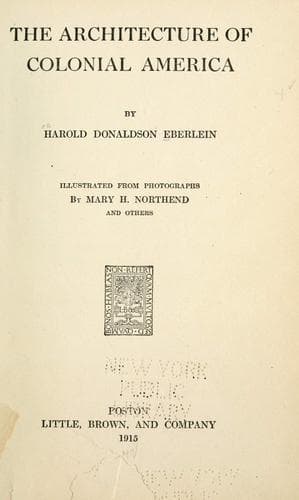
The Architecture of Colonial AmericaEberlein, Harold Donaldson
History
The Architecture of Colonial America
Eberlein, Harold Donaldson
Architecture -- United States; Architecture, Colonial
The Classic Revival had one of its early significant manifestations in
the buildings of the University of Virginia, a group for which we have
to thank no less a person than Thomas Jefferson. The plan embodied the
most comprehensive building scheme that had yet been essayed. To
Jefferson’s discriminating architectural taste and conscientious
devotion to his self-imposed task as architect and supervisor of the
work we owe it that the University buildings worthily represent one of
the best phases of revived classicism in America. There is a dignity and
honesty in Jefferson’s conception of revived classicism and a thorough
sincerity that often failed to appear in later work of the same school.
The result achieved commands our respect and when we remember that the
parts of plans and sections of details were jotted down on scraps of
paper and the backs of scribbled memoranda we cannot help wondering what
would have happened if the same seemingly careless and unsystematic
course were pursued in our own day. It was doubtless the enthusiastic
devotion of the architect and his constant supervision along with the
conscientious efforts and pride of every artisan that saved the day as
it did in so many other cases.
[Illustration: PENNSYLVANIA HOSPITAL, PHILADELPHIA.]
[Illustration: BLACK HORSE INN YARD, PHILADELPHIA.]
[Illustration: BRUTON PARISH CHURCH, WILLIAMSBURG, VA. 1714.]
CHAPTER XII
CHURCHES OF THE COLONIAL PERIOD
It is a far cry from the first place of worship contrived at Jamestown,
in 1607, to the stately fanes erected in the eighteenth century in all
the Colonies. Through each successive stage of development, however,
runs a thread of continuity corresponding to the material circumstances
of the colonists. Everywhere in the Colonies, the church building was an
exceedingly important structure and no one building or set of buildings,
in each community, more faithfully reflected the social and political as
well as the religious conditions of the colonists. Setting aside the
civic and defensive uses to which church edifices were often put,
especially in the earliest period, and confining ourselves to the purely
ecclesiastical side of their existence, we shall find them an invaluable
index to the varied aspects of the life of the times.
Public-domain text, read in full here on John Shaqi.
Reviews
Reviews
No reviews yet
Be the first to share your thoughts on this work.
Elsewhere in the archive
Join the Discussion
Join the discussion
Sign in to leave a comment or review.
Sign InorCreate an account