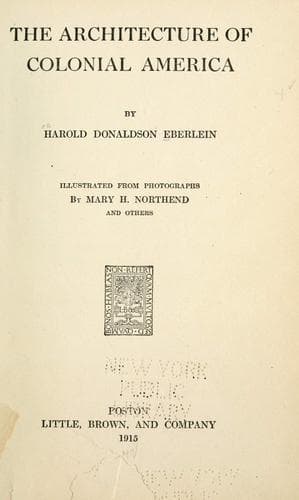
The Architecture of Colonial AmericaEberlein, Harold Donaldson
History
The Architecture of Colonial America
Eberlein, Harold Donaldson
Architecture -- United States; Architecture, Colonial
The materials of which any structure is built and the way in which those
materials are manipulated have quite as much to do with the general
aspect as mass or contour. It is of the utmost importance, therefore,
that we pay due heed to the material resources at the disposal of
builders in the Colonial period. Furthermore, it must be borne in mind
that materials to some extent influenced architectural forms while, on
the other hand, tradition and hereditary preferences, as we have seen,
exerted a powerful influence upon the choice of materials and affected
the way in which they were employed.
A very great number of the settlers of New England, as stated in a
previous chapter, came from the Danish parts of England where the timber
tradition was especially strong. Consequently, despite the abundance of
stone in the new land, which they might readily have used, they
preferred, in the majority of instances, to build their houses of wood.
Of course, some allowance, too, in this respect, must be made for ease
and expedition of working and for climatic conditions. In the Middle
Colonies and the South, most of the settlers came from the Saxon
portions of England where stone and brick traditions had always
prevailed and, although there was abundance of good timber and
occasionally some lack of other materials, there was a general
preference for brick or stone walls notwithstanding any inconvenience
incidental to procuring them. The artisans in each section preferred to
work with the materials with which they were most familiar and
householders also seem to have concurred in the popular choice. It is to
be noted that the lack of requisite material--marble or suitable
stone--had not a little to do with the common use of white-painted wood
for trims and external ornamental features in Georgian buildings whose
English prototypes, in many cases, were embellished with pillars,
pediments and cornices of the more durable substance.
It now behooves us to see what use was made of the several materials in
the various portions of the Colonies. We shall, of course, find brick
and stone structures in New England, and frame buildings in the Middle
Colonies and the South, but the preponderance numerically displayed the
characteristics just mentioned.
If “pigs is pigs”, doubtless, by the same token, “bricks is bricks” and
also “mortar is mortar.” Notwithstanding the profundity of this truism,
it is just as well to remember that there are bricks and bricks and that
there is mortar and mortar, too, and that both, when brought together in
a wall, mutually interact and are susceptible of large diversity of
treatment. This very possibility of different combination afforded the
Colonial builder a field for the exercise of not a little ingenuity.
For the benefit of readers not accustomed to technical terms it will,
perhaps, be well to explain exactly what is meant by the words “bond”
and “texture” which are necessarily used in speaking of brick masonry.
Public-domain text, read in full here on John Shaqi.
Reviews
Reviews
No reviews yet
Be the first to share your thoughts on this work.
Elsewhere in the archive
Join the Discussion
Join the discussion
Sign in to leave a comment or review.
Sign InorCreate an account