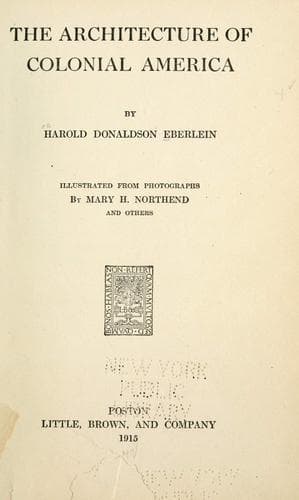
The Architecture of Colonial AmericaEberlein, Harold Donaldson
History
The Architecture of Colonial America
Eberlein, Harold Donaldson
Architecture -- United States; Architecture, Colonial
Another of the “fathers of architecture in the United States” was
Benjamin Latrobe, a man of extraordinary mental endowments, an
accomplished linguist and scholar, an eminent engineer and architect, a
gallant soldier and a typical gentleman of the old school with all the
best that such a designation implies. Born in 1767, the son of an
English Moravian clergyman in Yorkshire, he was educated in England and
achieved a promising position in his profession, being at one time
Surveyor of Public Offices of the City of London. In 1796, on the eve of
his coming to America, he was offered the post of a Crown Surveyor at
the annual salary of £1000 but, fortunately for American architecture,
he preferred to migrate. During the course of his professional career,
he carried many important engineering projects to a successful issue and
executed many notable architectural commissions. In this connexion he is
perhaps best known as the designer of the Roman Catholic Cathedral in
Baltimore, the Bank of the United States in Philadelphia and by his work
upon the Capitol building at Washington which he was called upon in 1803
to complete and which James Madison, in 1815, asked him to rebuild after
its partial demolition by the British troops in the War of 1812. His
pupil William Strickland of Philadelphia, by structures of his own
designing which included the old Maritime Exchange, the old Mint and
the Philadelphia Naval Asylum, buildings full of substantial dignity and
grace, paid a fitting tribute to Latrobe’s mastership and inspiration.
In the honourable roll of early American architects we must also
remember Major L’Enfant who so ably laid out the plan for the City of
Washington; James Hoban, whose Dublin training and youthful familiarity
with the best of English and Irish Georgian work peculiarly fitted him
for success in his treatment of the old State House at Charleston, South
Carolina, and the White House in Washington; John McComb, among whose
best known works are the City Hall of New York and St. John’s Chapel,
Varick street, and many more designers whose names and individual
achievements one would gladly recall did space permit. The reader,
however, notwithstanding the lack of further specific reference, cannot
fail to recognise from the memoranda already set forth how worthy has
been our architectural past, how able were the men to whom we are
indebted for it, how they worked and how fit are the examples they have
left for our study and emulation.
INDEX
A
Adam, Brothers, 111, 152, 170;
creations, 179;
elegance, 176;
influence, 105, 111, 119, 146, 151, 175;
mantel, 148, 149;
mode, 179;
_motifs_, 153;
oval, 148;
phase, 168, 170;
school, 173;
type, 164.
Adams, John, 123, 189.
Alexandria, Va., 159, 221.
Allis, John, 269.
Alterations, 39.
American Philosophical Society, 266.
André, Major, 200.
Annapolis, Md., 203, 209.
Anne Arundel Co., Md., 96, 162, 163.
Architect, carpenter, 252, 255;
early American, 252 _et seq._
Public-domain text, read in full here on John Shaqi.
Reviews
Reviews
No reviews yet
Be the first to share your thoughts on this work.
Elsewhere in the archive
Join the Discussion
Join the discussion
Sign in to leave a comment or review.
Sign InorCreate an account