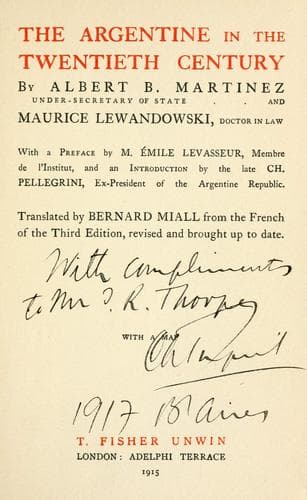
The Argentine in the Twentieth CenturyMartínez, Alberto B.
History
The Argentine in the Twentieth Century
Martínez, Alberto B.
Argentina -- Commerce; Argentina -- Economic conditions; Finance -- Argentina
The depreciation of rural property continued for some years. Thus,
in 1897, the Government sold by tender to the highest bidder a large
portion of its best lands, at the price of 3750 piastres, or £330 the
square league (about £36 the square mile), payable in five years, with
permission to pay in bonds of the patriotic loan, which then stood at
about 75 per cent.[61]
[Footnote 61: The piastre note, was then worth 1 franc 71——1s. 4·4d.,
or 34·2 per cent. of the par value. It was later fixed by law at 44 per
cent.——[TRANS.]]
This situation continued until 1902——a year which saw the settlement of
the old question of the Chili-Argentine frontier; a year of abundant
harvests and enormous development in the stock-raising world; a
development which took shape first in the export of cattle on the hoof
and then in the despatch of great quantities of chilled or frozen meat
to the English markets; a year which also saw the advent of a financial
stability resulting from the “law of monetary conversion,” which gave a
fixed value to paper money, the medium of all commercial transactions in
the interior. Then came a steady and decisive rise in the value of landed
property in general and of rural property in particular.
Since the beginning of this movement the value of the soil has steadily
increased; the last price is always greater than the previous one,
although the latter may have appeared stationary, if not final. This
being the case, we ought to ask whether this general rise responds
to permanent and sufficient causes, or if it is only the result of
capricious speculation, affecting landed property now as at another time
it affected paper money.
In reply to this question, Señor Roman Bravo, one of those Argentines who
are most familiar with all the complex aspects of land valuation,——for he
is the Director of the house of business[62] which transacts the greater
proportion of such operations——has at our request summed up, in the
following terms, the causes which at present determine the increase in
the value of property:——
[Footnote 62: The sales by auction conducted by this house during the
first six months of 1905 amounted to £2,376,000.]
“The economic life of the country offers at each step signs of further
progress. The enlargement of ports, the extension of railways, the
dredging of channels, the development of the building trade in the
chief city of the Republic, all show the spirit of enterprise at present
animating the individual and the people. Commerce and vigorous industries
reinforce these elements of prosperity and welfare.
Public-domain text, read in full here on John Shaqi.
Reviews
Reviews
No reviews yet
Be the first to share your thoughts on this work.
Elsewhere in the archive
Join the Discussion
Join the discussion
Sign in to leave a comment or review.
Sign InorCreate an account