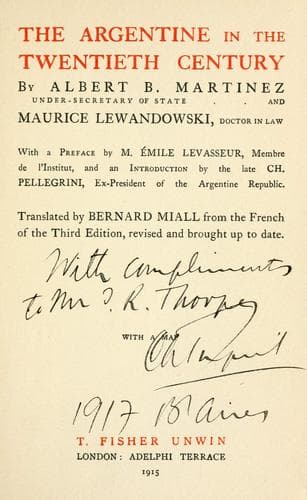
The Argentine in the Twentieth CenturyMartínez, Alberto B.
History
The Argentine in the Twentieth Century
Martínez, Alberto B.
Argentina -- Commerce; Argentina -- Economic conditions; Finance -- Argentina
Before commenting in any way upon the figures relating to foreign trade,
we must make one remark in respect of the method followed in making out
our balance-sheets, etc. In the case of imports, the valuation of the
customs is taken, and in the case of exports their current market price
in gold. But this procedure has the demerit of yielding results which are
not in strict correspondence with reality; the most we can say is that
they enable us to make a strict comparison of one year with another.
The valuations according to the customs are from 20 to 30 per cent.
above the true values in the case of the majority of articles, and are
sometimes merely fantastic.
To gain some idea of the disturbing factor which arises from the
calculation of imports upon the basis of customs estimates, which
estimates are the basis of the figures of the National Statistics, we
need only take the figures relating to coffee as an example. In 1899 it
was valued at 30 centavos in gold; in 1900, at 20; and in 1902, at 12
centavos (7·2d., 4·8d., and 2d.). This decrease of over 5d. in three
years only enables one to judge of the instability of this rate of
valuation.
Here are some examples of the tariff paid by certain imports into the
Argentine.
The 50 per cent. tariff strikes principally at the importation of
woven stuffs, carriages, harness, furniture, perfumery, ready-made
under-clothing, boots and shoes, hats, and similar articles not burdened
by specific tariffs, for there is a host of articles which pays the
entrance duty in this way. In practice this _ad valorem_ tariff of 50 per
cent. frequently becomes a tariff of 100 per cent. or more, on account of
the arbitrary nature of the customs valuations.
The 45 per cent. tariff affects stockings, socks, etc., exclusively.
The 40 per cent. tariff affects bales of unbleached linen, all kinds of
cotton cloth and calicoes, dressed leather, articles of lace made of pure
silk or silk mixtures, or of thread; woollen blankets, and blankets of
wool with cotton warp, or bound or bordered; also laces and silk thread
or thread of mixed silk and woven stuffs and any other articles of silk
or silk mixtures, including floss silk, etc.
The 35 per cent. tariff applies to woollen stuffs in general, whether of
pure wool or mixtures.
The 25 per cent. tariff affects all merchandise not burdened by a special
tax. That of 20 per cent. affects bar, strip and ribbon steel, and
unbleached cotton cloths.
The 15 per cent. tariff affects oak, cedar, pine, spruce, and tissues of
silk intended for bolting flour. The 10 per cent. tariff affects certain
chemical products, and also cocoa, tin, machinery in general, agave
fibres, jute, and hemp fibre for making mats, etc. That of 5 per cent.
which is the lowest, is imposed on turpentines, steel wire for fencing,
ploughs, jewellery, sulphur, cotton, whether raw or in the thread for
industrial purposes, sewing-thread, sacks, and other various articles.
Public-domain text, read in full here on John Shaqi.
Reviews
Reviews
No reviews yet
Be the first to share your thoughts on this work.
Elsewhere in the archive
Join the Discussion
Join the discussion
Sign in to leave a comment or review.
Sign InorCreate an account