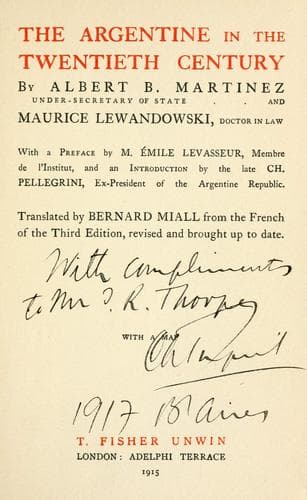
The Argentine in the Twentieth CenturyMartínez, Alberto B.
History
The Argentine in the Twentieth Century
Martínez, Alberto B.
Argentina -- Commerce; Argentina -- Economic conditions; Finance -- Argentina
We see that agricultural products were responsible for the enormous
increase in the trade statistics of 1908. They represented 66 per cent.
of the total exports, and had increased nearly 50 per cent. in one year.
The products of stock-raising have not increased; on the contrary, there
is a falling off of more than £5,000,000 between 1905 and 1908, the value
in 1905 being £28,208,597.
We see from the preceding data how greatly agriculture has developed
in the Argentine during the last few years. To realise precisely how
great this development has been, we need only recall the fact that the
exportation of corn is now 10,000 times greater than it was thirty years
ago: maize has increased by 800 per cent.; fodder, by 80 per cent.:
linseed, by 70,000 per cent.; flour more than 600 per cent.[81] These
figures show how rapid the growth of the Argentine has been, and what
progress has been realised in spite of temporary crises.
[Footnote 81: Latzina, work already cited, p. 510.]
If we now consider the progress of external trade, not from year to
year and in detail but as a whole, and over a large period, we can no
longer doubt that this trade is destined to accomplish still greater
development. Importation too, the field for which is somewhat restricted,
may also realise a greater progress as the population increases. Again,
once the Argentine develops her industries with greater energy, it is
only natural that larger quantities of raw material will be imported, to
be transformed into manufactured articles.
As for the increase of exports, we have only to turn to the data already
given concerning the annual increase in the area of sown land, and the
importance of those lands which have yet to reach their true value,
but will do so as soon as the stream of immigration supplies them with
settlers and colonists.
Moreover, the creation of a network of economical light railways, and the
opening of new ports on the great rivers, will give the export trade new
facilities, which will naturally result in an increased trade.
In the first edition of this book we remarked that there was still an
unknown factor in the future of the foreign trade of the Argentine.
Now there is, in the Presidential Message, an allusion to the eventual
termination of the commercial treaties with the principal nations, with
the intention of suppressing the “most favoured nation” clause, and of
opening up direct negotiations.
Very fortunately this measure has had no practical consequences, for the
revision of treaties is a delicate piece of work for a nation essentially
tributary to the foreigner, if one wishes to avoid the risk of provoking
reactions which might compromise the results already obtained.
Public-domain text, read in full here on John Shaqi.
Reviews
Reviews
No reviews yet
Be the first to share your thoughts on this work.
Elsewhere in the archive
Join the Discussion
Join the discussion
Sign in to leave a comment or review.
Sign InorCreate an account