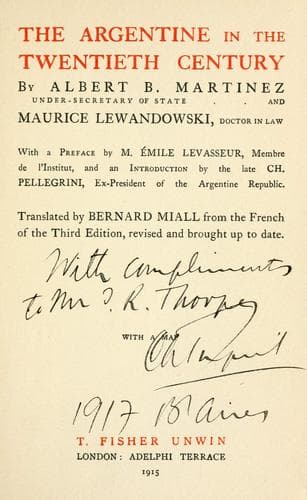
The Argentine in the Twentieth CenturyMartínez, Alberto B.
History
The Argentine in the Twentieth Century
Martínez, Alberto B.
Argentina -- Commerce; Argentina -- Economic conditions; Finance -- Argentina
As for the rates of discount, these have fallen considerably in the
last few years; partly on account of the increasing competition between
the various financial groups, and partly on account of the abundance of
capital after several years of good harvests. After standing for a long
time at 7 and 8 per cent., the average rate for first signatures tends
nowadays to settle at 6 per cent.
This is a fact which may surprise those who believe that the monetary
situation of a country is always affected by the premium on gold, but we
shall see, in the chapter on finance, that there is, as a matter of fact,
an influx of gold into the country, and that its movable resources have
never been more abundant. The circulation of notes is now guaranteed by a
cash reserve of more than 65 per cent.
The banks receive deposits at sight, at thirty, sixty, ninety, and one
hundred and eighty days. They also receive deposits on the “savings-bank”
system: that is they pay 3-1/2 or 4 per cent. upon deposits not exceeding
5000 to 10,000 piastres in paper money, or 3000 to 5000 in gold
(according to the particular bank)——that is, £440 to £880 in notes, £600
to £1000 in gold——on condition that if the money is withdrawn under sixty
days no interest will be allowed. After the lapse of sixty days the money
may be withdrawn at the will of the depositor, and the interest is added
since the day of deposit. Small savings deposited on this system attain
to considerable proportions, and the public is becoming more and more
familiarised with business of this kind.
One item that differs very sensibly from European usage is the rate of
interest charged on current debit accounts. As the Argentine has no law
regulating this rate, there have been times, happily now past by, when
this rate has been as high as 10 and 12 per cent. Of late years the
Government has paid, as a maximum, 6 to 7 per cent. and that in moments
of disequilibrium, when international complications were feared, and the
bank rates had risen in England and elsewhere.
For private individuals conditions are also easier, on account of
competition, and 7 per cent. has become practically the average rate. In
certain banks the rate on debit accounts has even fallen as low as 6 per
cent.
The following table indicates the movements of the principal accounts,
during the years 1906-1908, in the case of the various banks which
publish their balance-sheets, in the Argentine.
Public-domain text, read in full here on John Shaqi.
Reviews
Reviews
No reviews yet
Be the first to share your thoughts on this work.
Elsewhere in the archive
Join the Discussion
Join the discussion
Sign in to leave a comment or review.
Sign InorCreate an account