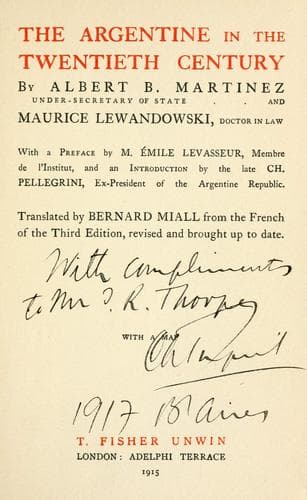
The Argentine in the Twentieth CenturyMartínez, Alberto B.
History
The Argentine in the Twentieth Century
Martínez, Alberto B.
Argentina -- Commerce; Argentina -- Economic conditions; Finance -- Argentina
_Money-lending or Mortgage Banks (Banques Hypothécaires)._ There are two
great official institutions of this kind in the Argentine: the _Mortgage
Bank National_ is progressing in a normal manner; the other, the
_Mortgage Bank of the Province of Buenos Ayres_, is painfully achieving
the process of liquidation.
We must explain that this institution, which worked for a number of years
with average regularity, collapsed violently in 1890, on account of the
scandalous abuses committed by the management in the matter of loans, and
the pernicious introduction of electoral politics into the conduct of
business. This is one of the most lamentable pages of the administrative
and financial history of the Argentine during the last few years.
After numerous efforts had been made at various times with a view to
making an arrangement between the bank and its creditors by means
of an exchange of its bonds of mortgage for new bonds of the _Rente
Provinciale_, a satisfactory agreement was at length arranged, which
put an end to the irregular situation of the bank, in a manner as
advantageous for the creditors as for the Province.
According to the report drawn up by the representative of the Government,
the liabilities of the bank amounted, on 30th June 1906, to £19,725,636;
and to set against this colossal debt the bank possessed the assets,
largely precarious, represented by 503 loans on mortgage, of which the
principal amounted to £1,967,704, while unpaid or overdue interest
accounted for £6,568,440; or a nominal total of £8,536,140.
The assets also comprised certain other items, amounting to a total of
£2,186,184.
Some of these assets had a real value and could be considered as capable
of realisation. Among these were: the money in the bank, the bank
premises, the mortgages, and the special accounts with the Provincial
Government; these items constituted the best class of assets. The
remaining assets were more precarious, and their investigation gave rise
to serious criticisms.
Two classes of assets, for example, which were apparently of considerable
importance——those relating to hypothecary credit and to personal
shares——were far from representing the value which was shown on the
balance-sheet.
Taking into account the probabilities of the realisation of certain
classes of assets, in case of need, a liability of £19,725,636 was
opposed by assets equivalent to £6,242,039, leaving a deficit of
£13,583,595. In other words, the assets represented only 31 per cent. of
the liabilities.
Public-domain text, read in full here on John Shaqi.
Reviews
Reviews
No reviews yet
Be the first to share your thoughts on this work.
Elsewhere in the archive
Join the Discussion
Join the discussion
Sign in to leave a comment or review.
Sign InorCreate an account