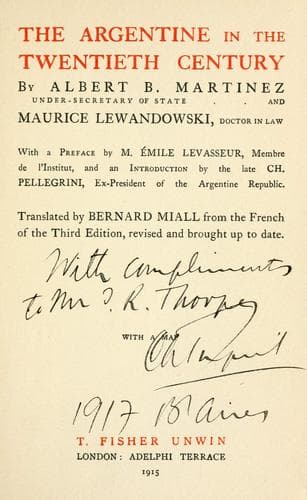
The Argentine in the Twentieth CenturyMartínez, Alberto B.
History
The Argentine in the Twentieth Century
Martínez, Alberto B.
Argentina -- Commerce; Argentina -- Economic conditions; Finance -- Argentina
The Argentine Republic possesses one of the most perfect systems of
mortgage in existence among modern nations. To prove this statement
we need only explain that the Argentine laws do not recognise secret
mortgages; nor do they admit any privileges in favour of married women or
minors in respect of special mortgages. Neither does such a thing exist
as a general mortgage, nor are there any privileges taking precedence
over the right of the mortgagee.
The mortgage, like every action which affects or modifies the right of
the proprietor over immovable property, must be signed before a notary
and registered by the Conservator of Mortgages. Before drawing up the
deed, the notary must, as in the case of sales, demand a certificate
stating whether the property is or is not free from charges. Although the
right of the proprietor is perfect as to possession, the law tends to
give property a certain degree of mobility; thus for this reason the term
of a sale with power of redemption is three years, the term of a lease
ten years, and that of the registration of a mortgage ten years; but all
these terms may be renewed upon expiration. The term of ten years in the
case of mortgages does not affect the _Banco Hypotecario National_, nor
the _Banque Hypothécaire de Buenos Ayres_, nor the _Banque Hypothécaire
de la Capitale_, in virtue of the special laws which created these
institutions.
_The Bourse or Exchange._——The first Commercial Exchange or Bourse, or
let us rather say the first institution to fulfil the functions of an
exchange or Bourse, for we cannot give that name to the market which
formerly existed in Buenos Ayres, was inaugurated in 1810 under the
name of the Chamber of Commerce——_Sala de Comercio_. It was composed
exclusively of members of the English colony, and offered them, besides
the usual advantages of such establishments, the attraction of a
well-furnished library.
The documents available do not tell us how long this institution lasted,
nor whether at a later period it opened its doors to the Argentine
element nor whether, being finally transformed, it served as a basis for
the organisation of the exchange as it is to-day. The only thing certain
is that in July 1834 the first members of the association met in the Via
San Martin, there to establish the Bourse, of which the inauguration took
place on the 1st of December following.
Before this date there was a financial group known as the “Sociedad
Particular de Corredores,” which was known as the _Camuati_, and which
busied itself with mercantile transactions.
The Bourse retained its original premises until the year 1862, when it
was installed in another building in the same street, at present occupied
by the Caisse de Conversion, or Bank of Exchange.
Public-domain text, read in full here on John Shaqi.
Reviews
Reviews
No reviews yet
Be the first to share your thoughts on this work.
Elsewhere in the archive
Join the Discussion
Join the discussion
Sign in to leave a comment or review.
Sign InorCreate an account