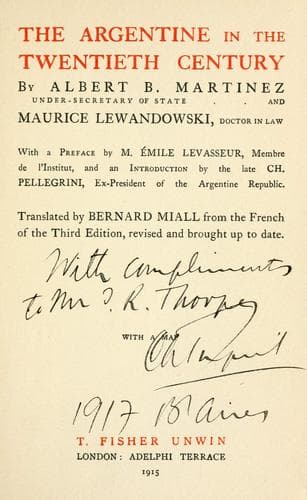
The Argentine in the Twentieth CenturyMartínez, Alberto B.
History
The Argentine in the Twentieth Century
Martínez, Alberto B.
Argentina -- Commerce; Argentina -- Economic conditions; Finance -- Argentina
In this total of $835,000,000 of paper-money we find that transactions in
gold amounted to $774,000,000 paper money, corresponding to $66,800,000
of gold negotiated; while in 1899, the whole business done in the Bourse
still amounted to the respectable sum of $1,295,000,000 paper, of which
$1,234,000,000 represented operations in gold. From one year to another
the total sum of the business transacted in the Bourse had diminished by
$460,000,000 (paper).
The principal cause of this notable decrease was the “law of monetary
conversion.”
This law, which has been in force since 1890, fixed the value of 44
centavos, or $44 gold, for the future conversion of paper-money, and
enacted that the Caisse de Conversion should receive the gold and deliver
paper, and _vice versa_, at this same rate: a rate equivalent to 227·27
per cent. The effect of this reform was thus, if not to destroy, at least
very largely to limit unbridled speculation, which made itself especially
felt in the value of the paper piastre.
Speculation in gold being suppressed, the volume of business transacted
on the Bourse de Commerce of Buenos Ayres grew gradually less and less,
falling finally, in 1904, to $37,312,000 paper, of which $19,968 stood
for gold.
After 1904 the total sum of these operations was still further reduced,
the figures for 1908 being incredibly low. Thus the total, which in
1905 had attained £45,400,000, rose to £57,800,000 in 1906, fell in
1907 to £16,880,000, and in 1908 to £12,560,000. To-day the activity of
speculators is concentrated upon operations in mortgage bonds and the
shares of various companies; each class of operations amounting to some
£5,000,000. These figures show that the Bourse de Commerce loses from day
to day some part of its importance as the regulating centre of mercantile
transactions; but it would be an error to measure the economic vitality
of the Republic by the amount of business effected on the Bourse, since
an examination of the situation shows us that the Argentine has never
known a period of more obvious prosperity.
* * * * *
Having explained the new phase upon which the Buenos Ayres Bourse has
entered, we must now consider its organisation and its usages, and the
regulations under which it operates.
In the first place we must remark that the Bourse is not an official
institution, but a private establishment, founded and supported by a
limited liability company, the “Bolso de Comercio,” which is recognised
as a judicial body.
In contrast to other Exchanges, and that of New York in particular,
the number of shareholders is unlimited, and varies from time to time.
In 1886 there were 2959; in 1891, 4901; in May 1905, 3709. To become a
member of the Bourse one must be presented by two shareholders, admitted
by the Council Chamber or Committee (_Chambre Syndicate_), and must pay a
moderate entrance fee, as well as an annual subscription.
Public-domain text, read in full here on John Shaqi.
Reviews
Reviews
No reviews yet
Be the first to share your thoughts on this work.
Elsewhere in the archive
Join the Discussion
Join the discussion
Sign in to leave a comment or review.
Sign InorCreate an account