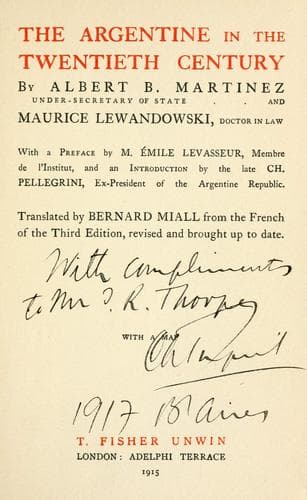
The Argentine in the Twentieth CenturyMartínez, Alberto B.
History
The Argentine in the Twentieth Century
Martínez, Alberto B.
Argentina -- Commerce; Argentina -- Economic conditions; Finance -- Argentina
The total sum of national, provincial, and municipal expenses.
The proportion per inhabitant——Comparison with other foreign
countries in the matter of administrative expenses.
The national revenue——The revenue as organised by the Constitution,
and its analysis——Indirect taxation——The customs the chief
source of revenue——Direct taxation; its origin in the
Argentine; its justification; its yield——Revenue of the
industrial undertakings belonging to the State: railways,
sewers, posts and telegraphs——The exploitation of the State
lands.
Elasticity of the receipts, which follow the development and
progress of the country——The accelerated increase of
expenditure, and the resulting chronic deficit——Necessity of
serious reforms.
The phenomenon of an increase in the national expenditure: a phenomenon
which makes itself felt under monarchies as well as under republics, in
those countries which have long centuries of life behind them, as in
those whose independent existence has barely begun: this phenomenon is
felt in the Argentine Republic more keenly than in the older nations of
Europe. Our book would present a serious lacuna if we did not, before
speaking of the increase of the Argentine budgets, inquire first of all,
as closely as we can in a work of information, what are the causes which
have led to this continual increase in the national expenses. We must
know, in short, whether this increase is due to general causes, produced
by administrative necessities, and connected with the mere progress of
the country, or whether on the contrary it arises from special factors,
peculiar to the social and political conditions of the country, and to
the practical defects of its Government. If we examine the amounts of
the Argentine budgets for a number of years, we shall see that, with a
few rare exceptions, they have always increased, and at a more or less
extraordinary rate. Even in the years when the country was groaning under
some profound economic or financial crisis the same thing was to be
observed.
Not to go back too far in our retrospective study, let us take as a
point of departure the year 1891, which year is a veritable landmark in
the history of the Argentine people, since it was in that year that the
political and financial crisis which broke over the country attained its
greatest intensity. We find that in 1891 the expenditure authorised by
the national budget——not the expenditure actually effected, with which
we shall deal further on——amounted to $41,230,349 paper and $20,315,446
gold, or some 31 millions in gold, or £6,200,000.
Public-domain text, read in full here on John Shaqi.
Reviews
Reviews
No reviews yet
Be the first to share your thoughts on this work.
Elsewhere in the archive
Join the Discussion
Join the discussion
Sign in to leave a comment or review.
Sign InorCreate an account