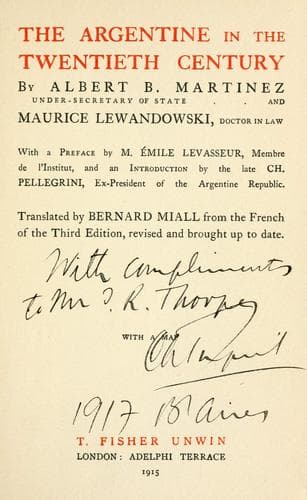
The Argentine in the Twentieth CenturyMartínez, Alberto B.
History
The Argentine in the Twentieth Century
Martínez, Alberto B.
Argentina -- Commerce; Argentina -- Economic conditions; Finance -- Argentina
We shall ultimately have occasion to inquire how far this debt weighs
upon the resources of the Treasury, what the burden per inhabitant
amounts to, and how it stands in relation to the debts of other
countries. For the moment we must glance backward in order to realise
the historical conditions under which this debt was contracted, and what
its destination has been.[102] The first credit transaction effected by
the Republic abroad was concluded a few years after the Declaration of
Independence. In 1822 the Province of Buenos Ayres, which had always
been the heart and head of the Republic, taking its place, indeed,
under certain conditions, and under others representing it in foreign
countries, was fortunate in having at its head a progressive Government,
which, by its profitable initiative, has left ineradicable traces behind
it. The President was General Martino Rodriguez; the Ministers included
Bernadino Rivadavia and Manuelo-Josepho Garcia.
[Footnote 102: See, in _The North American Review_ for May 1902, an
article by Señor Alberto Martinez, entitled: “National Debts of the
World. IX. Public Debt of Argentina.”]
This Government cast its eyes over the empty surface of the vast
Argentine territory; it saw immense wealth unexploited, for lack of the
necessary elements; it realised its great need of material progress,
and understood, with a just and clairvoyant judgment, that of all these
needs the most urgent were the construction of a port for the exchange of
products with the outside world, the instalment of a water supply which
would ensure health to the inhabitants, and the establishment of villages
along the line of the new frontier, serving as desert outposts, and
constituting a military pale to withstand and confine the irruptions of
the savage Indians.
For the realisation of these then important undertakings of public
utility the Government of 1822 resolved to obtain the necessary
resources, by raising a loan of a million sterling, giving as
consideration a dividend of 6 per cent. and an annual redemption of 1 per
cent.; the House of Baring to act as agents for the loan. Unhappily the
executive power employed the resources furnished by this transaction in
founding a bank which had a very short existence, and the intended public
works were not effected. More than half a century elapsed before their
realisation.
Public-domain text, read in full here on John Shaqi.
Reviews
Reviews
No reviews yet
Be the first to share your thoughts on this work.
Elsewhere in the archive
Join the Discussion
Join the discussion
Sign in to leave a comment or review.
Sign InorCreate an account