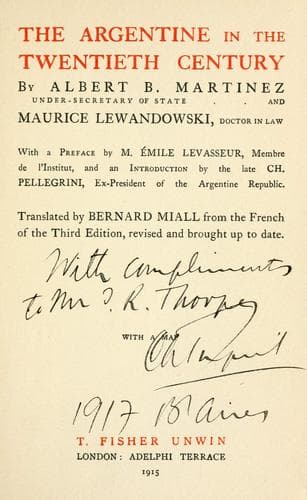
The Argentine in the Twentieth CenturyMartínez, Alberto B.
History
The Argentine in the Twentieth Century
Martínez, Alberto B.
Argentina -- Commerce; Argentina -- Economic conditions; Finance -- Argentina
“The bonds of that debt were quoted on the London Exchange; but in
time they were quoted no more, for they had at length lost all value;
even their name was erased. A day came, however, when the children of
Argentina’s creditors went to search for their bonds among forgotten
papers; and the bonds were redeemed. For many that was a day of
legitimate surprise; the bearers had offered their paper to their debtors
at any price; but now they were told that they would receive its written
value. It was enough for them that they should be paid in future; but
they were told that even the arrears of interest and amortisation should
be arranged by means of new stock, which was known as Deferred Bonds.
“When, among its assets, a nation possesses such a trait in its life as
this——a trait unique in the financial history of the nations——it has the
right to hold its head erect, affirming its honour and its credit.”
Since that date, and during thirty-six years, the country scrupulously
paid the interest on its debt, until the disastrous year of 1890, when,
as a result of the financial and political crisis, the most violent the
country had ever suffered, the payment of the foreign debt began to be
a matter of serious consideration for the Administration. Many schemes
were proposed to help the State tide over that difficult time; but none
of them included the repudiation of the debt. The Government then at the
head of affairs accepted the most onerous of these schemes, because it
was that which was most to the advantage of its creditors.
The arrangement then decided on, known as the _Morituri_ loan, or Morgan
loan, has been the subject of severe criticism; but one thing was not
and will not be debated, namely, the noble and patriotic intention which
inspired the authors of this transaction, and resolved them to safeguard
the worthy traditions of Argentine credit. By respecting their foreign
liabilities they served the truest interests of their country, and
respected also the spirit of the Constitution, which holds that credit,
and foreign credit in particular, should be the great constitutional
resource, placed in the hands of Governments “for the urgent needs of the
nation, or for undertakings of national ability.”
CHAPTER III
THE DOUBLE CURRENCY
The persistence of the double currency——The history of paper money——
The origins of the premium on gold, and its almost continual
increase——The year 1890 and the depreciation of the currency——
The causes of this depreciation; abuses in the issue of paper,
caused by a bad financial and administrative policy.
Public-domain text, read in full here on John Shaqi.
Reviews
Reviews
No reviews yet
Be the first to share your thoughts on this work.
Elsewhere in the archive
Join the Discussion
Join the discussion
Sign in to leave a comment or review.
Sign InorCreate an account