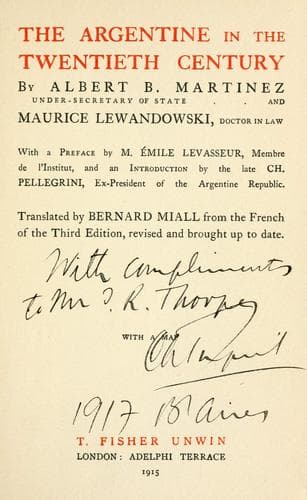
The Argentine in the Twentieth CenturyMartínez, Alberto B.
History
The Argentine in the Twentieth Century
Martínez, Alberto B.
Argentina -- Commerce; Argentina -- Economic conditions; Finance -- Argentina
Dominated by circumstances, it issued in 1890 $35,116,000, in order to
legalise the excess of an issue delivered to the National Bank and the
Bank of the Province of Buenos Ayres. In the course of the same year it
created an issue of 60 millions more, in order to furnish the National
Bank with 25 millions, the National Mortgage Bank with 25 millions,
and the City of Buenos Ayres with 10 millions. In 1891 it issued 50
millions in order to found the Bank of the Argentine Nation, and finally
5 millions more for the Mortgage Bank. In short, urged by necessity, the
Government created $150,000,000 of paper in two years, which on the top
of a previous issue of $161,766,590 in paper was naturally followed by
disastrous results.
The Government which took charge of the administration in 1892 also
manifested, in its programme, its firm intention of increasing the value
of paper money by its gradual redemption; an operation which would,
of course, be the duty of the _Caisse de Conversion_. To this end it
included the necessary sums in the budget, and $865,426 were burned in
1893 and $8,000,394 in 1894. But the results obtained by this measure
were far from responding to the hopes which were founded upon it;
although the Government religiously and with much solemnity, burned on
the 15th of each month a determined sum of paper money——usually half a
million——the value of paper, far from rising, fell further and further
below that of gold.
The Government finally saw that its plan was useless; and hastened to
explain itself by the mouth of its Minister of Finance, who declared that
“the executive power recognises that the withdrawal of eight millions of
piastres per annum cannot fundamentally alter the price of our paper; but
what it does affirm is that this quantity will be sufficient, provided
the production of the country increases, provided that the exports exceed
the imports; that is to say, provided that the international balances are
in favour of the Republic.”
We may say in passing that these two desired factors were realised; but
not the expected advantage, for the Government again made the mistake of
issuing 15 millions of internal stock, bearing interest (£1,320,000),
while at the same time it extinguished another debt, also domestic, which
did not bear interest.
All these details prove in a conclusive fashion that the original and
organic functions of the _Caisse de Conversion_ were inverted from the
time of its creation; converting that institution into a factor of
depression in all that concerned the paper currency, instead of being the
instrument of increasing its value.
Public-domain text, read in full here on John Shaqi.
Reviews
Reviews
No reviews yet
Be the first to share your thoughts on this work.
Elsewhere in the archive
Join the Discussion
Join the discussion
Sign in to leave a comment or review.
Sign InorCreate an account