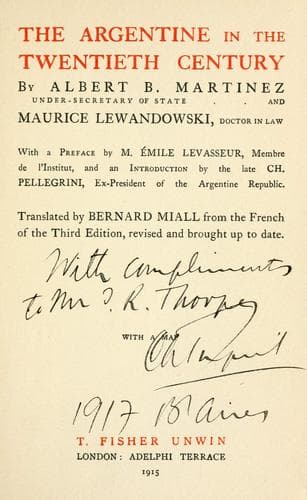
The Argentine in the Twentieth CenturyMartínez, Alberto B.
History
The Argentine in the Twentieth Century
Martínez, Alberto B.
Argentina -- Commerce; Argentina -- Economic conditions; Finance -- Argentina
Only in 1903 did the operations of the _Caisse de Conversion_ amount to
anything. The two principal causes of this state of affairs were, firstly
the settlement of the frontier dispute with Chili, a question which had
caused serious alarm, and had resulted in enormous official expenses
during the few previous years; and secondly the size of the commercial
balances. Bearing this in mind, it is not surprising that the amount of
gold in the _Caisse de Conversion_, and, consequently the issues of
paper money, should have commenced to increase and have continued to do
so until they reached the proportions which they have since attained.
In 1903 £9,208,284 in gold was taken, and £1,576,625 paid out; leaving
£7,648,229. The busiest months were April, when £2,519,048 was taken, and
March, when the takings were £1,738,395. The largest outgoings were in
March and July, amounting respectively to £239,133 and £222,104.
In succeeding years the metallic reserve of the _Caisse de Conversion_
has continually increased, thanks to the favourable sense of the economic
balances of the nation’s trade, and the capital which has entered the
Republic, to be employed in the establishment of new industries, or the
creation of railways, tramways, etc.
At the time of writing the metallic reserve of the _Caisse de Conversion_
has lately increased to £34,752,058, which, added to the £5,100,000 of
the Conversion Fund, gives a total of £39,852,058. The proportion of
these reserves to the paper currency in circulation is to-day 65.9 per
cent.
According to the law the increase of the metallic balance in the _Caisse
de Conversion_ has inevitably caused, as a natural consequence, the
parallel increase of the issues of notes, nickel, and silver, of which
the amount in circulation increased to $688,177,998 on 31st October 1909,
or $393,028,267 more than on 31st December 1899, the year in which the
law of monetary conversion was voted, and in which the same circulation
amounted to $295,149,731.
The rapidity with which the emission of paper has increased has caused
certain journals, and especially those which have been prominent in
attacking the law of monetary conversion (whose beneficial effects they
were yet powerless to deny) to raise cries of alarm, thinking to see
in this increase a future economic peril, or the seeds of a dangerous
crisis, due to the inflation which, in their judgment, is produced by
such issues. But it is easy to prove that these alarms are not justified
from the moment when such issues are guaranteed by a corresponding
deposit of metallic currency in the _Caisse de Conversion_. Moreover,
a very little reflection will show that one cannot help admitting that
this gold, being the product of the ever-increasing economic balances
of the country, will affect the monetary situation equally if instead of
being in reserve in the _Caisse de Conversion_ it is to be found in the
strong-rooms of private banks.
Public-domain text, read in full here on John Shaqi.
Reviews
Reviews
No reviews yet
Be the first to share your thoughts on this work.
Elsewhere in the archive
Join the Discussion
Join the discussion
Sign in to leave a comment or review.
Sign InorCreate an account