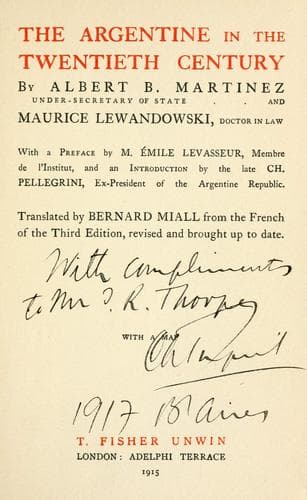
The Argentine in the Twentieth CenturyMartínez, Alberto B.
History
The Argentine in the Twentieth Century
Martínez, Alberto B.
Argentina -- Commerce; Argentina -- Economic conditions; Finance -- Argentina
The time has come to sum up our conclusions, and we cannot do better than
attempt to present the figures of the movements of the capital invested
in the Argentine, and by stating, as far as possible, its yield. We have
already had occasion to declare that Europe has not turned her attention
to the young South American Republic for sentimental reasons, nor on
account of the beauty of her political institutions nor the splendour of
her landscapes. What interests the general public is the extraction of
the riches of the Argentine soil; the economic and industrial expansion
of the country, and its fitness as a field for investment and original
enterprise.
To respond to this mental attitude we have thought it proper to undertake
a dry and impartial inquiry into the value of the capital invested in the
Argentine, and the total of its yield. Capital represented by movable
values is the only factor which has in some sense an official existence
which is amenable to control; it lends itself to statistics sufficiently
precise to allow of our estimating, from this point of view, the wealth
of a country; and it is consequently in this direction that we may
search for a standard with which to compare the favourable estimates
expressed in our preceding chapters on the subject of the development and
prosperity of the Argentine Republic.
This inventory will lead us to other data, which are equally instructive.
In reviewing the movable values and in estimating their yield we shall at
the same time examine into the general movement of foreign capital and
its earnings, so that we shall be able approximately to state the amount
and the profits of the capital invested by the various European nations
which have dealt with this country.
By the aid of these statistics we shall finally see the situation
of the Argentine, which the results of its foreign trade have shown
us only imperfectly, in its true light. Although the country has an
extremely favourable commercial balance, which in 1908 was not less than
£24,000,000, this sum has to support enormous charges for the payment
of interest on loans placed abroad: the dividends of railway companies,
of banking houses, of all manner of land companies, of commercial and
industrial companies, whose shareholders are abroad, etc. etc. These are
the sums we are trying to determine, in order to draw up as exactly as
possible the balance-sheet of the Argentine.
This chapter will therefore be devoted to estimating on the one hand what
the country owes to foreign capital, and on the other hand what profit
foreign capital draws from its investment in the Argentine. It is to some
extent the current account of Europe and the Argentine that we wish
to present, taking as our basis the movable values, which are the only
serious data upon which we can base our inquiry.[113]
Public-domain text, read in full here on John Shaqi.
Reviews
Reviews
No reviews yet
Be the first to share your thoughts on this work.
Elsewhere in the archive
Join the Discussion
Join the discussion
Sign in to leave a comment or review.
Sign InorCreate an account