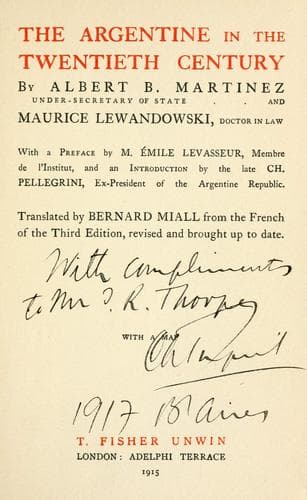
The Argentine in the Twentieth CenturyMartínez, Alberto B.
History
The Argentine in the Twentieth Century
Martínez, Alberto B.
Argentina -- Commerce; Argentina -- Economic conditions; Finance -- Argentina
As for the importation of bullion and the visible existence of gold
in the country, it will serve our purpose to know that according to
the official figures there was on the 31st of December 1907 a total
of £29,060,000 in the country, which was distributed as follows:
£21,020,000 in the _Caisse de Conversion_, and £8,040,000 in the various
banks, including the Conversion Funds. A year later, on the 31st of
December 1908, these figures attained a total of £34,860,000, of which
£25,340,000 was in the _Caisse_, and £9,520,000 in the various banks.
But in the course of the year 1909 this upward movement has been even
more evident, since the total amount of gold in the Republic on the 1st
of November 1909 was no less than £53,800,000, of which £34,800,000 was
in the _Caisse_ and £19,200,000 in the banks or the Conversion Fund.
It is already therefore certain, if we are to judge by the important
consignments of gold actually on the way to the Argentine, that by the
end of 1909 the Republic will possess metallic funds to the amount of at
least £56,000,000.
We have seen what a part foreign capital has taken in realising the
economic value of the Argentine and the influence it has exerted in
developing the country. It is employed in the greatest variety of ways:
in State loans, railways, and every branch of industry. To it we owe
harbours and railways; that is, the principal factors of economic wealth;
it is foreign capital, invested in navigation companies, which puts the
Argentine in touch with all the nations which consume her products.
However, placing ourselves at the standpoint of the laws of evolution
which preside over the destinies of the nations, we must admit that,
in view of the present prosperity of the country, the intervention of
foreign capital in the affairs of the Republic must daily lessen, in
proportion as a national reserve of capital collects; as has happened
in the United States, and in all states which are in the first rank
of civilisation. But the term of this economic movement is still far
removed, and until the day arrives, foreign capital will in all security
continue to find employment in navigation and in public works, and also
in those nascent industries which are beginning to exploit the mineral
wealth of the Republic.
CONCLUSIONS
This volume does not call for a long summary; for we have, we believe,
in the course of our enquiry, thrown sufficient light upon the
characteristic aspects of the situation of the Argentine to enable the
reader to judge of the place it now holds in the world-market among the
great producing nations. But what does remain for us to do is to sum up
in broad touches the fundamental progress realised in the last few years;
a degree of progress to which the country is indebted for its modern
prosperity, and which bears the seeds of its future development.
Public-domain text, read in full here on John Shaqi.
Reviews
Reviews
No reviews yet
Be the first to share your thoughts on this work.
Elsewhere in the archive
Join the Discussion
Join the discussion
Sign in to leave a comment or review.
Sign InorCreate an account