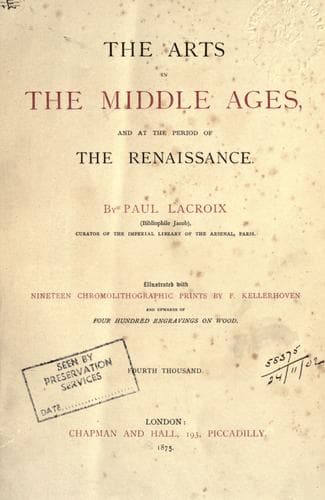
The Arts in the Middle Ages and at the Period of the RenaissanceJacob, P. L.
History
The Arts in the Middle Ages and at the Period of the Renaissance
Jacob, P. L.
Art, Medieval; Art, Renaissance; Middle Ages
In treating of ecclesiastical furniture we, moreover, observed that the
goldsmith’s art, although devoting itself to secular ornaments,
nevertheless continued to work marvels in the production of objects for
ecclesiastical use; it would be mere repetition to support this
assertion by other examples.
[Illustration: Fig. 98.--An Ancient Cameo-setting of the time of Charles
V. (Cab. of Ant., Bibl. Imp., Paris.)]
But, dismissing those two questions, let a contemporary poet raise a
third, which deserves a place here. Eustache Deschamps, who died in
1422, equerry and usher-at-arms to Charles V. and Charles VI.,
enumerates the jewels and gems which the female nobility of the time
aspired to possess. “It was indispensable,” he says--
“Aux matrones,
Nobles palais et riches trônes;
Et à celles qui se marient
Qui moult tôt (bientôt) leurs pensers varient,
Elles veulent tenir d’usaige ...
Vestements d’or, de draps de soye,
Couronne, chapel et courroye
De fin or, espingle d’argent ...
Puis couvrechiefs à or batus,
A pierres et perles dessus ...
Encor vois-je que leurs maris,
Quand ils reviennent de Paris,
De Reims, de Rouen et de Troyes,
Leur rapportent gants et courroyes ...
Tasses d’argent ou gobelets ...
Bourse de pierreries,
Coulteaux à imagineries,
Espingliers (étuis) taillés à émaux.”
They desired, moreover, and said that they ought to have given to them--
“Pigne (peigne) et miroir d’ivoire ...
Et l’estui qui soit noble et gent (riche et beau),
Pendu à chaines d’argent;
Heures (livres de piété) me fault de Notre-Dame,
Qui soient de soutil (delicat) ouvraige,
D’or et d’azur, riches et cointes (jolies),
Bien ordonnés et bien pointes (peintes),
De fin drap d’or très-bien couvertes,
Et quand elles seront ouvertes,
Deux fermaux (agrafes) d’or qui fermeront.”
We thus see that, according to the above programme, the jewel-box of a
princess, or of a lady of rank, must have been really splendid.
Unfortunately for us, the specimens of these female ornaments of the
fourteenth and fifteenth centuries are still more rare in collections
than objects of massive plate; and one is almost left to imagine their
appearance and their richness from the entries in inventories, that
chief source of information regarding the times of which the memorials
have disappeared.
Public-domain text, read in full here on John Shaqi.
Reviews
Reviews
No reviews yet
Be the first to share your thoughts on this work.
Elsewhere in the archive
Join the Discussion
Join the discussion
Sign in to leave a comment or review.
Sign InorCreate an account