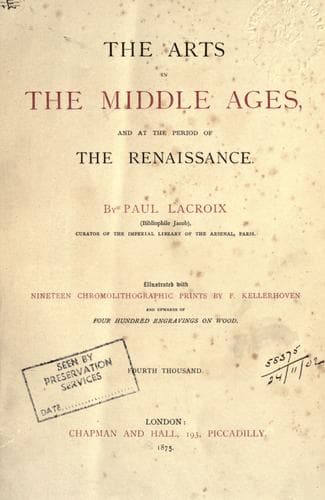
The Arts in the Middle Ages and at the Period of the RenaissanceJacob, P. L.
History
The Arts in the Middle Ages and at the Period of the Renaissance
Jacob, P. L.
Art, Medieval; Art, Renaissance; Middle Ages
generally considered the most skilful goldsmith of his time (Figs. 101
and 102). However that may be, the style of the goldsmith’s art of the
fifteenth century continued, as in the two or three preceding centuries,
conformable to the contemporaneous style of architecture. For instance,
the shrine of Saint-Germain-des-Près, which was of that period, had the
form of a small ogivale[16] church; and some specimens still existing in
Berlin are of the Gothic character, the prevailing style of the edifices
of those times. But an influence was making itself felt that was not
long in entirely modifying the general aspect of the productions of the
trade we are considering. That transformation must have been promoted by
Italy; in the midst of which, in spite of intestine troubles and serious
contentions with other nations, a luxury and opulence prevailed. Genoa,
Venice, Florence, Rome, had long been so many centres where the Fine
Arts struggled for pre-eminence and inspiration. Among the majority of
the wealthy merchants who had
[Illustration: Fig. 102.--Escutcheon in Silver-gilt, executed by
Corneille de Bonte, in the Fifteenth Century. (Museum of the Hôtel de
Ville, Ghent.)]
become patricians of those gorgeous republics were found so many
Mæcenases, under whose patronage flourished great artists whom popes and
princes emulously countenanced. “From the moment,” says M. Labarte,
“when the Nicolases, the Jeans of Pisa, and the Giottos, throwing off
the Byzantine yoke, caused Art to emerge from languor and supineness,
that of the goldsmith could no longer find favour in Italy but by
maintaining itself on a level with the progress of sculpture, whose
daughter it was.[17] When we know that the great Donatello,--Philip
Brunelleschi, the bold architect of the dome of Florence,--Ghiberti, the
author of the marvellous doors of the Baptistery, had goldsmiths for
their earliest masters, we may judge what artists the Italian goldsmiths
of that period must have been.” The first in date is the celebrated Jean
of Pisa, son of Nicolas, who, brought from Arezzo in 1286, to sculpture
the marble table of the high-altar, and a group of the Virgin between
St. Gregory and St. Donato, desired to pay tribute to the taste of the
time by ornamenting the altar with those fine chasings on silver
coloured with enamels to which we give the name of translucid enamels in
relief; and also by designing a clasp or jewel with which he decorated
the breast of the Virgin. Both chasings and clasp are now lost.
To Jean (Giovanni) of Pisa succeeded his pupils Agostino and Agnolo of
Siena.
Public-domain text, read in full here on John Shaqi.
Reviews
Reviews
No reviews yet
Be the first to share your thoughts on this work.
Elsewhere in the archive
Join the Discussion
Join the discussion
Sign in to leave a comment or review.
Sign InorCreate an account