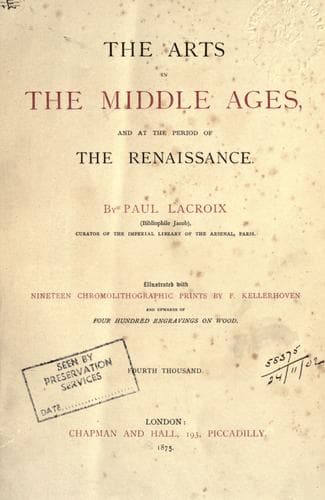
The Arts in the Middle Ages and at the Period of the RenaissanceJacob, P. L.
History
The Arts in the Middle Ages and at the Period of the Renaissance
Jacob, P. L.
Art, Medieval; Art, Renaissance; Middle Ages
The list would be long of goldsmiths who, by the single force of their
talents, or under the direction of renowned sculptors, competed during
two centuries in the production of the marvellous works with which the
churches of Italy are still crowded; and in fact it would be only a
monotonous detail, the interest of which can scarcely be enhanced by any
description we could give of their works. Nevertheless, we may cite the
most illustrious of them: for instance, Andrea Verrochio, in whose
studio Perugino and Leonardo da Vinci passed their time; Domenichino
Ghirlandajo, so called because when a goldsmith he had invented an
ornament in the form of garlands, of which the ladies of Florence were
passionately fond; he afterwards relinquished the hammer and the graver
for the painter’s pencil; Maso Finiguerra, who, reputed to be the
cleverest niello-worker of his time, engraved a _pax_, or paten, still
preserved in the cabinet of bronzes in Florence; it is acknowledged to
be the plate of the first engraving printed,--the Imperial Library of
Paris possesses the only early proof of it.
In 1500 was born Benvenuto Cellini, who was to be the embodiment of the
genius of the goldsmith’s art, and who raised it to the zenith of its
power. “Cellini, a Florentine citizen, now a sculptor,” as his
contemporary Vasari relates, “had no equal in the goldsmith’s art when
devoting himself to it in his youth, and was perhaps for many years
without a rival, as well as in the execution of small figures in full
relief and in bas-relief, and all works of that nature. He mounted
precious stones so skilfully, and decked them in such marvellous
settings, with small figures so perfect, and sometimes so original and
with such fanciful taste, that one could not imagine anything better;
nor can we adequately praise the medals which, when he was young, he
engraved with incredible care in gold and silver. At Rome he executed,
for Pope Clement VII., a fastening for the cope, in which he represented
with admirable workmanship the Eternal Father. He also mounted with rare
talent a diamond, cut to a point, and surrounded by several young
children carved in gold. Clement VII. having ordered a gold chalice with
its cup supported by the theological attributes, Benvenuto executed the
work in a surprising manner. Of all the artists who, in his own time,
tried their hands at engraving medals of the Pope, no one succeeded
better, as those well know who possess them or have seen them. Also to
him was entrusted the execution of the coins of Rome; and finer pieces
were never struck. After the death of Clement VII., Benvenuto returned
to Florence, where he engraved the head of Duke Alexander on the coins,
which are so beautiful that to this day several specimens are preserved
as precious antique medals; and rightly so, for in them Benvenuto
surpassed himself. At length he devoted himself to sculpture and to the
art of casting statues. He executed in France, where he was in the
Public-domain text, read in full here on John Shaqi.
Reviews
Reviews
No reviews yet
Be the first to share your thoughts on this work.
Elsewhere in the archive
Join the Discussion
Join the discussion
Sign in to leave a comment or review.
Sign InorCreate an account