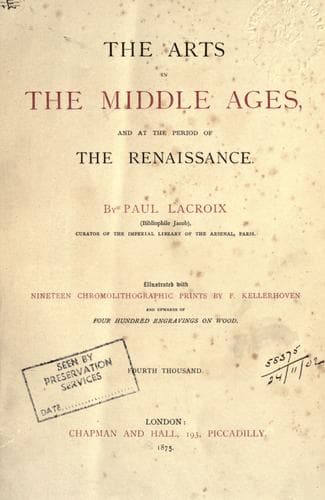
The Arts in the Middle Ages and at the Period of the RenaissanceJacob, P. L.
History
The Arts in the Middle Ages and at the Period of the Renaissance
Jacob, P. L.
Art, Medieval; Art, Renaissance; Middle Ages
Having finished this sketch of the goldsmith’s art in general, it may
not be inappropriate to add a brief notice of the more special history
of the French goldsmiths, of which the wealthy corporation may be
considered not only as the most ancient, but as the model of all those
that were formed among us in the Middle Ages. But first, since we have
already referred to the exceptional part taken by the goldsmiths of
Limoges in the industrial movement of that period, we cannot proceed
further without noting another description of works, which, although
derived from the oldest examples, nevertheless gave, and with justice, a
kind of new lustre to the ancient city where the first goldsmiths of
France had distinguished themselves.
“Towards the end of the fourteenth century,” says M. Labarte, “the taste
for gold and silver articles having led to the disuse of plate of
enamelled copper, the Limousine enamellers endeavoured to discover a new
mode of applying enamel to the reproduction of graphic subjects. Their
researches led them to dispense with the chaser for delineating the
outlines of designs; the metal was entirely concealed under the enamel,
which, spread by the brush, formed altogether both the drawing and the
colouring. The first attempts at this novel painting on copper were
necessarily very imperfect; but the processes gradually improved, until
at length, in 1540, they attained perfection. Prior to that period, the
enamels of Limoges were almost exclusively devoted to the reproduction
of sacred subjects, of which the German school furnished the designs.
But the arrival of Italian artists at the court of Francis I., and the
publication of engravings of the works of Raphael and other great
masters of Italy, gave a new direction to the school of Limoges, which
adopted the style of that of Italy. Il Rosso and Primaticcio painted
cartoons for the Limousine enamellers; and then
[Illustration: DRAGEOIR, OR TABLE ORNAMENT
Of Enamelled and Gilt Copper. German, latter part of Sixteenth
Century.]
they who had previously worked only on plates intended to be set in
diptychs, on caskets, created a new species of goldsmith’s art. Basins,
ewers, cups, salt-cellars, vases, and utensils of all sorts,
manufactured with thin sheet-copper in the most elegant forms were
decorated with their rich and brilliant paintings.”
In the highest rank of artists who have rendered this attractive work
illustrious we must place Léonard (Limousin), painter to Francis I., who
was the first director of the royal manufacture of enamels founded by
that king at Limoges. Then followed Pierre Raymond (Figs. 107 to 110),
whose works date from 1534 to 1578, the Penicauds, Courteys, Martial
Raymond, Mercier, and Jean Limousin, enameller to Anne of Austria.
[Illustration: Figs. 107 and 108.--Faces of an Hexagonal Enamelled
Salt-cellar, representing the Labours of Hercules. Executed at Limoges,
for Francis I., by Pierre Raymond.]
Public-domain text, read in full here on John Shaqi.
Reviews
Reviews
No reviews yet
Be the first to share your thoughts on this work.
Elsewhere in the archive
Join the Discussion
Join the discussion
Sign in to leave a comment or review.
Sign InorCreate an account