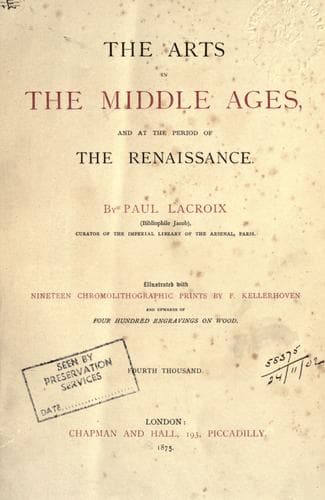
The Arts in the Middle Ages and at the Period of the RenaissanceJacob, P. L.
History
The Arts in the Middle Ages and at the Period of the Renaissance
Jacob, P. L.
Art, Medieval; Art, Renaissance; Middle Ages
But after the commencement of the tenth century many individuals, and
especially poets, had invented rhythmical songs, which were entirely
different from those of the Church. “Harmony formed by successions of
various intervals,” as we are told by the author whom we have before
quoted, “obtained in the eleventh century the name of _discantus_, in
old French _déchant_. Francon de Cologne is the most ancient author who
makes use of this word. During the whole course of the eleventh century
the composition of melody was independent of harmony, and henceforth the
composition of music was divided into two very distinct parts. The
people, and poets and persons in high life, constructed the melody and
the words; but being ignorant of the science of music, they resorted to
a professional musician to have their inspirations written down. The
first were very justly called _trouvères_ (_trobadori_), the others the
_déchanteurs_, or harmonisers. Harmony was then only adapted for two
voices--a combination of fifths, and of movements in unison.
“In the twelfth century, the construction of melody continued to be in
the hands of poets. The _déchanteurs_ or harmonisers were the
professional musicians. Popular songs became very numerous. Troubadours
multiplied all over Europe, and the greatest lords deemed it an honour
to cultivate both poetry and music. Germany had her ‘master-singers,’
who were in request at every court. In France, the Châtelain de Coucy,
the King of Navarre, the Comte de Béthune, the Comte d’Anjou, and a
hundred others acquired a brilliant reputation by songs, of which they
composed both the words and the melody. The most celebrated of these
_trouvères_ was Adam de la Halle, who flourished in 1260.”
In the fourteenth century, the name of _counterpoint_ was substituted
for that of _déchant_; and in 1364, at the coronation of Charles V. at
Rheims, a mass was sung which was written in four parts, composed by
Guillaume de Machault, poet and musician.
Among the ancients the number of musical instruments was considerable,
but their names were even still more numerous, because derived from the
shape, the material, the nature and character of the instruments, all of
which varied infinitely, according to the whim of the maker or the
musician. Added to this, every country had its national instruments; and
as each in its own language designated them by descriptive names, the
same instrument appeared under ten different denominations, and a
similar name was applied to ten instruments. However, having nothing but
monumental representation to guide us, and in the absence of the
instruments themselves, an almost inextricable confusion arises.
Public-domain text, read in full here on John Shaqi.
Reviews
Reviews
No reviews yet
Be the first to share your thoughts on this work.
Elsewhere in the archive
Join the Discussion
Join the discussion
Sign in to leave a comment or review.
Sign InorCreate an account