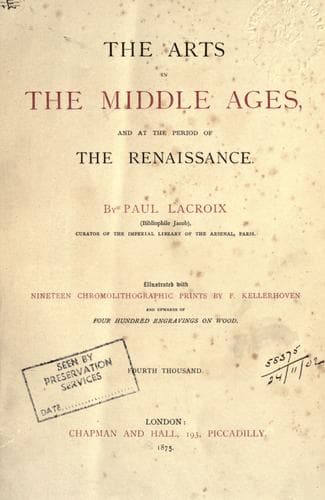
The Arts in the Middle Ages and at the Period of the RenaissanceJacob, P. L.
History
The Arts in the Middle Ages and at the Period of the Renaissance
Jacob, P. L.
Art, Medieval; Art, Renaissance; Middle Ages
The use of pulsatile instruments producing a metallic sound increased
greatly in Europe, especially after the return from the Crusades. But
even before this date the Egyptian timbrel was used in religious and
festival music; this instrument was composed of a circle whereon rings
were hung, which tinkled as they struck together when the timbrel was
shaken. The Oriental triangle was also used on these occasions; this was
almost the same then as it is at the present day.
The drum has always been a hollow case covered with a stretched skin,
but the shape and size of this instrument have caused great variations
in its name, and also in the way in which it was used. In the Middle
Ages it was called _taborellus_, _tabornum_, and _tympanum_. It
generally made its appearance in festal music, and especially in
processions; but it was not until the fourteenth century that it began
to take a place in military bands, at least in France; the Arabians,
however, have used it from the earliest ages. In the thirteenth century
the _taburel_ was a kind of tambourine, played on with only a
drum-stick; in the _tabornum_ we may recognise the military drum of the
present day; and the _tympanum_ was equivalent to our tambourine.
Sometimes, as seen in a sculpture in the Musicians’ Hall at Rheims, this
instrument was attached to the right shoulder of the performer, who
played upon it by striking it with his head, while at the same time he
blew through two metal flutes communicating with the inside of the drum
(Fig. 177).
[Illustration: Fig. 176.--Chime of Bells of the Ninth Century. (MS. de
Saint-Blaise.)]
[Illustration: Fig. 177.--_Tympanum_ of the Thirteenth Century.
(Sculpture on the Musicians’ Hall, Rheims.)]
We have now to speak of stringed instruments, the whole of which may be
divided into three principal classes: those played on by the fingers,
those that are struck, and those which are rubbed (_frottées_) by means
of some appliance.
As a matter of fact, there are some stringed instruments which may be
said to belong to all three of these classes, as all three modes of
playing upon them has been adopted either simultaneously or in
succession.
The most ancient are doubtless those that are played on by the fingers,
first among which, in right of its antiquity, we must name the lyre;
from this have sprung the cithern, the harp, the psaltery, the
_nabulon_, &c. In the Middle Ages, however, considerable confusion arose
from the fact that these original names were at the time often diverted
from their real acceptation.
The lyre, the stringed instrument _par excellence_ of the Greeks and
Romans, preserved its primitive form as late as the tenth century. The
strings were generally of twisted gut, but sometimes also of brass wire,
and varied in number from three to eight. The sounding-box, which was
always placed at the lower part of the instrument, was more often made
of wood than of either metal or tortoise-shell (Fig. 178).
Public-domain text, read in full here on John Shaqi.
Reviews
Reviews
No reviews yet
Be the first to share your thoughts on this work.
Elsewhere in the archive
Join the Discussion
Join the discussion
Sign in to leave a comment or review.
Sign InorCreate an account