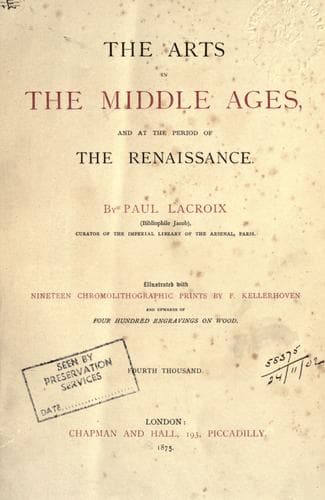
The Arts in the Middle Ages and at the Period of the RenaissanceJacob, P. L.
History
The Arts in the Middle Ages and at the Period of the Renaissance
Jacob, P. L.
Art, Medieval; Art, Renaissance; Middle Ages
In the sixteenth century, however, it began to fall into disfavour; it
was supplanted by the lute (Fig. 192), an instrument much used in the
thirteenth century, and by the guitar, which was brought into fashion in
France from Spain and Italy, and formed the delight both of the court
and private circles. At that time every great lord, imitating kings and
princesses, wished to have his lute or guitar player, and the poet
Bonaventure des Périers, _valet de chambre_ of Marguerite de Navarre,
composed for her “La Manière de bien et justement entoucher les Lucs et
Guiternes.” The lute and the guitar, which for about two centuries were
in high favour in what was called “chamber music,” have since the
above-named epoch scarcely been altered in shape. With certain
modifications, however, they gave rise to the _theorbo_ and the
_mandolin_, which never attained more than a transient or local favour.
[Illustration: Fig. 191.--Minstrel’s Harp, of the Fifteenth Century.
(MS. in the _Miroir Historial_ of Vincent de Beauvais.)]
[Illustration: Fig. 192.--Five-stringed Lute. Thirteenth Century. (MS.
in the Bibl. Imp., Paris.)]
Stringed instruments that were played on by means of bows were not known
before the fifth century, and belonged to the northern races; they did
not become prevalent in Europe generally until after the Norman
invasion. At first they were but roughly made and rendered indifferent
service to musical art; but from the twelfth to the sixteenth century,
these instruments were subject to many changes both in form and name,
and were brought to perfection according as the execution of musicians
also improved. The most ancient of these instruments is the _crout_
(Fig. 193), which must have produced the _rote_, so dear to the
minstrels and the _trouvères_ of the thirteenth century. The _crout_,
which is the instrument placed by tradition in the hands of the
Armorican, Breton, and Scotch bards,[24] was composed of an oblong
sounding-box, more or less hollowed out at the two sides, with a handle
fixed in the body of the instrument, in which were made two openings
that allowed the performer to hold it by the left hand and at the same
time to touch the strings; these, as a matter of principle, were only
three in number. Subsequently it had four strings, and then six--two of
which were played open (_à vide_). The musician played on it with a
straight or convex bow, provided with a single thread either of iron
wire or of twisted hair. Except in England, where the _crout_ was
national, it did not last beyond the eleventh century. It was replaced
by the _rote_, which was not, as its name (apparently derived from
_rota_, a wheel) would seem to intimate, a _vielle_ or _symphonie_. It
would be useless to seek for the derivation of the name of _rota_,
except in the word _crotta_, the Latin form of the term _crout_.
[Illustration: Fig. 193.--Three-stringed _Crout_ of the Ninth Century.
From a Miniature.]
Public-domain text, read in full here on John Shaqi.
Reviews
Reviews
No reviews yet
Be the first to share your thoughts on this work.
Elsewhere in the archive
Join the Discussion
Join the discussion
Sign in to leave a comment or review.
Sign InorCreate an account