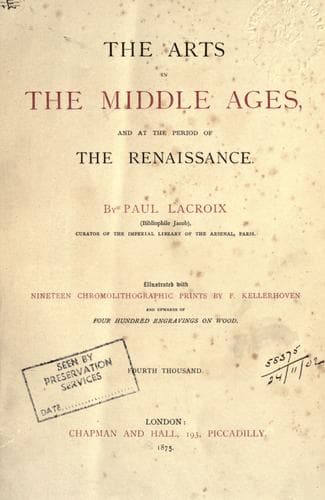
The Arts in the Middle Ages and at the Period of the RenaissanceJacob, P. L.
History
The Arts in the Middle Ages and at the Period of the Renaissance
Jacob, P. L.
Art, Medieval; Art, Renaissance; Middle Ages
On the 29th of January, 1392, there was a grand _fête_ at the mansion of
Queen Blanche in honour of the marriage of a Chevalier de Vermandois
with one of the queen’s ladies. The king, Charles VI., had only just
recovered from his mental malady. One of his favourites, Hugonin de
Janzay, projected an entertainment in which the king and five lords were
to take a part. “It was,” says Juvénal des Ursins, “a masquerade of wild
men chained together, and all shaggy; their dress was made to fit close
to their body, and was rendered rough by flax and tow fastened on by
resinous pitch, greased so as to shine the better.” Froissart, who was
an eye-witness of this _fête_, says that the six actors in the _ballet_
entered the hall yelling and shaking their chains. As it was not known
who these maskers were, the Duke of Orleans, brother of the king,
wishing to find out, took a lighted torch from the hands of his servant,
and held it so close to one of these strange personages that “the heat
of the fire caught the flax.” The king was fortunately separated from
his companions, who were all burned, with the exception of one only, who
threw himself into a tub full of water. Although Charles VI. escaped
from this peril, he was deeply affected by the thought of the danger to
which he had been exposed, and the result was a relapse into his former
insanity.
This fearful _ballet des ardents_ left such an impression on the minds
of people generally, that seventy years afterwards a German engraver
made it the subject of a print. Should we, then, be venturing on an
inadmissible hypothesis if we attribute to a cardmaker of this epoch the
idea of introducing the same subject in a pack of cards? which, as is
abundantly proved, was modified according to the whim of the artist. In
order to justify the costume of a female savage and the torch, which
are given to the “queen of hearts,” we must not forget that Isabel of
Bavaria, consort of Charles VI., is accused of having assisted in
devising this fatal masquerade, which was intended to get rid of the
king; and of having taken as her accomplice the Duke of Orleans, her
brother-in-law, who is said to have purposely set fire to the clothing
of these pretended wild men, among whom was the king.
Public-domain text, read in full here on John Shaqi.
Reviews
Reviews
No reviews yet
Be the first to share your thoughts on this work.
Elsewhere in the archive
Join the Discussion
Join the discussion
Sign in to leave a comment or review.
Sign InorCreate an account